JEE Advance - Mathematics (2005)
- 2If the incident ray on a surface is along the unit vector $$\widehat v\,\,,$$ the reflected ray is along the unit vector $$\widehat w\,\,$$ and the normal is along unit vector $$\widehat a\,\,$$ outwards. Express $$\widehat w\,\,$$ in terms of $$\widehat a\,\,$$ and $$\widehat v\,\,.$$
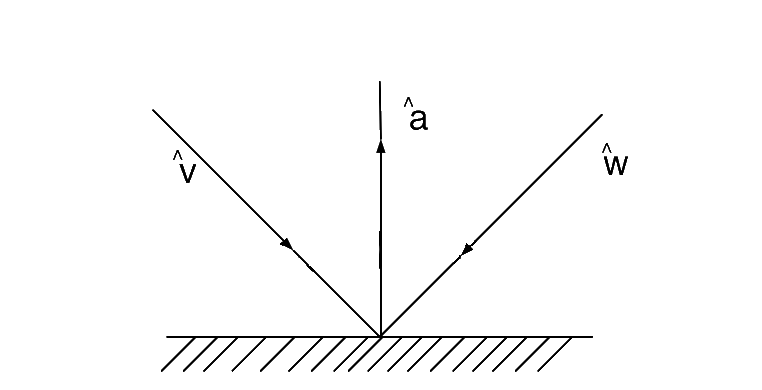 Cevap(C)$$\widehat w = \widehat v - 2(\widehat a \cdot \widehat v)\widehat a$$
 - 2If $$\overrightarrow a \,,\,\overrightarrow b ,\overrightarrow c $$ are three non-zero, non-coplanar vectors and
$$\overrightarrow {{b_1}} = \overrightarrow b - {{\overrightarrow b .\,\overrightarrow a } \over {{{\left| {\overrightarrow a } \right|}^2}}}\overrightarrow a ,\overrightarrow {{b_2}} = \overrightarrow b + {{\overrightarrow b .\,\overrightarrow a } \over {{{\left| {\overrightarrow a } \right|}^2}}}\overrightarrow a ,$$
$$\overrightarrow {{c_1}} = \overrightarrow c - {{\overrightarrow c .\,\overrightarrow a } \over {{{\left| {\overrightarrow a } \right|}^2}}}\overrightarrow a + {{\overrightarrow b .\,\overrightarrow c } \over {{{\left| c \right|}^2}}}{\overrightarrow b _1},\,\,\overrightarrow {{c_2}} = \overrightarrow c - {{\overrightarrow c .\,\overrightarrow a } \over {{{\left| {\overrightarrow a } \right|}^2}}}\overrightarrow a - {{\overrightarrow b \,.\,\overrightarrow c } \over {{{\left| {{{\overrightarrow b }_1}} \right|}^2}}}{\overrightarrow b _1},$$
$$\overrightarrow {{c_3}} = \overrightarrow c - {{\overrightarrow c .\,\overrightarrow a } \over {{{\left| {\overrightarrow c } \right|}^2}}}\overrightarrow a + {{\overrightarrow b .\,\overrightarrow c } \over {{{\left| c \right|}^2}}}{\overrightarrow b _1},\,\,\overrightarrow {{c_4}} = \overrightarrow c - {{\overrightarrow c .\,\overrightarrow a } \over {{{\left| {\overrightarrow c } \right|}^2}}}\overrightarrow a - {{\overrightarrow b \,.\,\overrightarrow c } \over {{{\left| {{{\overrightarrow b }_1}} \right|}^2}}}{\overrightarrow b _1},$$
then the set of orthogonal vectors isCevap(B)$$\left( {\overrightarrow a ,\overrightarrow {{b_1}} ,\overrightarrow {{c_2}} } \right)$$ - 4A person goes to office either by car, scooter, bus or train, the probability of which being $${1 \over 7},{3 \over 7},{2 \over 7}$$ and $${1 \over 7}$$ respectively. Probability that he reaches office late, if he takes car, scooter, bus or train is $${2 \over 9},{1 \over 9},{4 \over 9}$$ and $${1 \over 9}$$ respectively. Given that he reached office in time, then what is the probability that he travelled by a car.Cevap(A)1/7
- 6$$f(x)$$ is a differentiable function and $$g(x)$$ is a double differentiable
function such that $$\left| {f\left( x \right)} \right| \le 1$$ and $$f'(x)=g(x).$$
If $${f^2}\left( 0 \right) + {g^2}\left( 0 \right) = 9.$$ Prove that there exists some $$c \in \left( { - 3,3} \right)$$
such that $$g(c).g''(c)<0.$$Cevap(A)Rolle's Theorem - 7If $$\left[ {\matrix{ {4{a^2}} & {4a} & 1 \cr {4{b^2}} & {4b} & 1 \cr {4{c^2}} & {4c} & 1 \cr } } \right]\left[ {\matrix{ {f\left( { - 1} \right)} \cr {f\left( 1 \right)} \cr {f\left( 2 \right)} \cr } } \right] = \left[ {\matrix{ {3{a^2} + 3a} \cr {3{b^2} + 3b} \cr {3{c^2} + 3c} \cr } } \right],\,\,f\left( x \right)$$ is a quadratic
function and its maximum value occurs at a point $$V$$. $$A$$ is a point of intersection of $$y=f(x)$$ with $$x$$-axis and point $$B$$ is such that chord $$AB$$ subtends a right angle at $$V$$. Find the area enclosed by $$f(x)$$ and chord $$AB$$.Cevap(B)125/3 sq. units - 12If $$P(x)$$ is a polynomial of degree less than or equal to $$2$$ and $$S$$ is the set of all such polynomials so that $$P(0)=0$$, $$P(1)=1$$ and $$P'\left( x \right) > 0\,\,\forall x \in \left[ {0,1} \right],$$ thenCevap(B)$$S = ax + \left( {1 - a} \right){x^2}\,\,\forall \,a \in \left( {0,2} \right)$$
- 13Find the equation of the common tangent in $${1^{st}}$$ quadrant to the circle $${x^2} + {y^2} = 16$$ and the ellipse $${{{x^2}} \over {25}} + {{{y^2}} \over 4} = 1$$. Also find the length of the intercept of the tangent between the coordinate axes.Cevap(A)$$y = -\frac{2}{\sqrt{3}}x + 4\sqrt{\frac{7}{3}}, \,\,\,\,\frac{14}{\sqrt{3}}$$
- 18Find the range of values of $$\,t$$ for which $$$2\,\sin \,t = {{1 - 2x + 5{x^2}} \over {3{x^2} - 2x - 1}},\,\,\,\,\,t\, \in \,\left[ { - {\pi \over 2},\,{\pi \over 2}} \right].$$$Cevap(C)$$\left[ {{{ - \pi } \over 2},\,{{ - \pi } \over {10}}} \right]\, \cup \,\left[ {{{3\pi } \over {10}},\,{\pi \over 2}} \right]$$
- 21The value of $$$\left( {\matrix{ {30} \cr 0 \cr } } \right)\left( {\matrix{ {30} \cr {10} \cr } } \right) - \left( {\matrix{ {30} \cr 1 \cr } } \right)\left( {\matrix{ {30} \cr {11} \cr } } \right) + \left( {\matrix{ {30} \cr 2 \cr } } \right)\left( {\matrix{ {30} \cr {12} \cr } } \right)....... + \left( {\matrix{ {30} \cr {20} \cr } } \right)\left( {\matrix{ {30} \cr {30} \cr } } \right)$$$
is where $$\left( {\matrix{ n \cr r \cr } } \right) = {}^n{C_r}$$Cevap(A)$$\left( {\matrix{ {30} \cr {10} \cr } } \right)$$