JEE MAIN - Physics (2007)
- 10Two identical conducting wires $$AOB$$ and $$COD$$ are placed at right angles to each other. The wire $$AOB$$ carries an electric current $${I_1}$$ and $$COD$$ carries a current $${I_2}$$. The magnetic field on a point lying at a distance $$d$$ from $$O$$, in a direction perpendicular to the plane of the wires $$AOB$$ and $$COD$$ , will be given byCevap(C)$${{{\mu _0}} \over {2\pi d}}{\left( {I_1^2 + I_2^2} \right)^{{1 \over 2}}}$$
- 14A charged particle with charge $$q$$ enters a region of constant, uniform and mutually orthogonal fields $$\overrightarrow E $$ and $$\overrightarrow B $$ with a velocity $$\overrightarrow v $$ perpendicular to both $$\overrightarrow E $$ and $$\overrightarrow B, $$ and comes out without any change in magnitude or direction of $$\overrightarrow v $$. ThenCevap(B)$$\overrightarrow v = \overrightarrow E \times \overrightarrow B /{B^2}$$
- 17If $${g_E}$$ and $${g_M}$$ are the accelerations due to gravity on the surfaces of the earth and the moon respectively and if Millikan's oil drop experiment could be performed on the two surfaces, one will find the ratio
$${{electro\,\,ch\arg e\,\,on\,\,the\,\,moon} \over {electronic\,\,ch\arg e\,\,on\,\,the\,\,earth}}\,\,to\,be$$Cevap(B)$$1$$ - 18A parallel plate condenser with a dielectric of dielectric constant $$K$$ between the plates has a capacity $$C$$ and is charged to a potential $$V$$ volt. The dielectric slab is slowly removed from between the plates and then reinserted. The net work done by the system in this process isCevap(A)zero
- 19Charges are placed on the vertices of a square as shown. Let $$\overrightarrow E $$ be the electric field and $$V$$ the potential at the center. If the charges on $$A$$ and $$B$$ are interchanged with those on $$D$$ and $$C$$ respectively, then
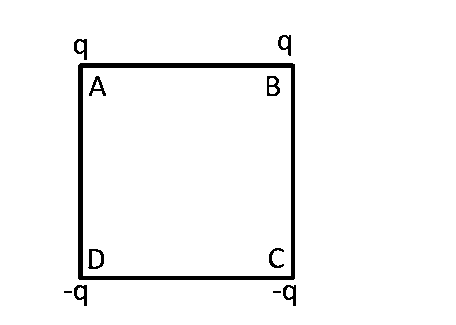 Cevap(A)$$\overrightarrow E $$ changes, $$V$$ remains unchanged
 - 20The potential at a point $$x$$ (measured in $$\mu \,m$$) due to some charges situated on the $$x$$-axis is given by $$V\left( x \right) = 20/\left( {{x^2} - 4} \right)$$ volt
The electric field $$E$$ at $$x = 4\,\mu \,m$$ is given byCevap(A)$$(10/9)$$ volt / $$\mu $$ $$m$$ and in the $$ + ve$$ $$x$$ direction - 22An electric charge $${10^{ - 3}}\,\,\mu \,C$$ is placed at the origin $$(0,0)$$ of $$X-Y$$ co-ordinate system. Two points $$A$$ and $$B$$ are situated at $$\left( {\sqrt 2 ,\sqrt 2 } \right)$$ and $$\left( {2,0} \right)$$ respectively. The potential difference between the points $$A$$ and $$B$$ will beCevap(C)zero
- 28One end of a thermally insulated rod is kept at a temperature $${T_1}$$ and the other at $${T_2}$$. The rod is composed of two sections of length $${L_1}$$ and $${L_2}$$ and thermal conductivities $${K_1}$$ and $${K_2}$$ respectively. The temperature at the interface of the two section is
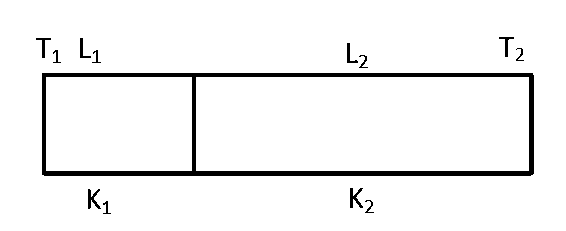 Cevap(D)$${{\left( {{K_1}{L_2}{T_1} + {K_2}{L_1}{T_2}} \right)} \over {\left( {{K_1}{L_2} + {K_2}{L_1}} \right)}}$$
 - 35A block of mass $$m$$ is connected to another block of $$mass$$ $$M$$ by a spring (massless) of spring constant $$k.$$ The block are kept on a smooth horizontal plane. Initially the blocks are at rest and the spring is unstretched. Then a constant force $$F$$ starts acting on the block of mass $$M$$ to pull it. Find the force of the block of mass $$m.$$Cevap(D)$${{mF} \over {\left( {m + M} \right)}}$$