Viruses are considered to be living organisms because they
Cevap
(A)
possess transmittable characters
2
Which of the following characteristics is common to Amoeba and Paramecium?
Cevap
(C)
Contractile vacuole
3
Hydra removes undigested food by
Cevap
(B)
passing it through the mouth
4
Which of the following groups of invertebrates reproduces by budding?
Cevap
(D)
Coelenterata
5
The algae, bryophytes and pteridophytes are similar in that they
Cevap
(C)
require moisture for fertilization
6
The spores of ferns are dispersed by
Cevap
(A)
wind
7
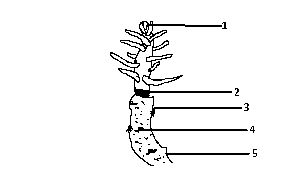
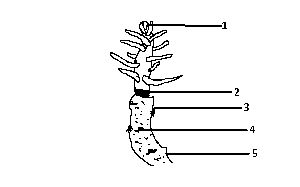
The part labelled 3 is the
Cevap
(C)
auxillary bud
8
Which part of the twig produces auxins?
Cevap
(D)
1
9
Which of the following animals has homodont dentition?
Cevap
(C)
Lizard
10
In which of the following does external fertilization takes place?
Cevap
(A)
Toad
11
In the tapeworm the suckers on the scolex are used for
Cevap
(B)
holding fast to the host
12
A feature which adapts birds to flight is the possession of
Cevap
(B)
light bones
13
The nephridia in the earthworm form part of the
Cevap
(D)
excretory system
14
which of the following disease is rarely spread by a housefly?
Cevap
(A)
Yellow fever
15
Which type of the following cells is thin-walled and living at maturity?
Cevap
(B)
Sieve tube
16
The mode of nutrition in which digestion is extracellular is
Cevap
(D)
saprophytic
17
The first step in the process of photosynthesis is the
Cevap
(A)
activation of the chlorophyll
18
Which of the following food substance will produce a brick-red colour when warmed with Benedict's solution?
Cevap
(A)
Glucose
19
The organ which secretes digestive enzymes as well as hormones is the
Cevap
(C)
pancreas
20
The vilius in the small intestine is significant because it
Cevap
(A)
increase the surface area for absorption
21
If a ring of bark and phloem is removed from a stem, the
Cevap
(D)
movement of minerals is hardly affected
22
Transpiration can be measured with a
Cevap
(C)
potometer
23
Excretory products responsible for the red, purple and blue colours of flowers are called
Cevap
(C)
anthocyanins
24
Etiolation is caused by the influence of
Cevap
(D)
light
25
Muscles are indirectly attached to bones by means of
Cevap
(C)
tendons
26
During mammalian embryo development, large amounts of oestrogen and progesterone are produced in the
Cevap
(C)
placenta
27
Fruits which develop without fertilization are described as
Cevap
(B)
pathencorpic
28
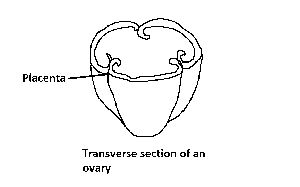
The type of placentation shown in the figure above is a
Cevap
(A)
parietal
29
The elephant grass is propagated vegetatively by means of
Cevap
(D)
stolons
30
The part of the ear that is concerned with balance is the
Cevap
(A)
semi-circular canals
31
In organism where the 2nd number of chromosomes is 16, the number of chromosomes in each gamete will be
Cevap
(C)
8
32
What will be the result of the first filial generation (F1) and the second filial generation (F2) of a mono-hybrid cross between pure line normal-winged Drosophilia flies and pure line short-winged flies, if the gene for the normal wing is dominant?
Cevap
(D)
F1 flies all normal-winged and three-quarters of F2 flies are normal-winged
33
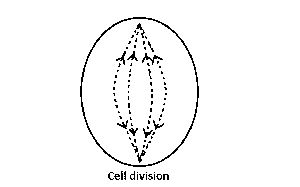
What stage during cell division is represented in the figure above?
Cevap
(C)
Anaphase
34
An individual in the AB blood group is a universal recipient for blood donation because
Cevap
(D)
there are no anti-A and anti-B antibodies in the serum
35
Haemophilia results from the mutation of the genes
Cevap
(A)
in the sex chromosome
36
In a savanna ecosystem the abiotic factors include
Cevap
(B)
water, temperature and soil
37
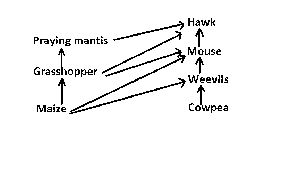
Which of the following is an omnivore?
Cevap
(C)
Mouse
38
which of the organisms will have the lowest population in an ecosystem?
Cevap
(A)
Hawk
39
The salinity of a brackish enviroment
Cevap
(D)
increase during dry season
40
Physiological adaptation to very dry condition in animals is called
Cevap
(B)
aestivation
41
Which set of disease is spread mainly by insect vectors?
Cevap
(D)
Malaria, cholera and river blindness
42
Which of the following constitute pollution?
Cevap
(B)
loud disco sound
43
An acidic soil can be improved upon by
Cevap
(C)
flocculation
44
What do bacteria in root nodules derive from the host plant?