Which of the following groups of animals do not possess a nervous system?
Sagot
(A)
Porifera
2
The structural similarities in Paramecium and Euglena are in the
Sagot
(B)
blunt anterior and pointed posterior
3
Which of the following organisms cannot exist freely on its own?
Sagot
(D)
Plasmodium
4
Which of the following cell organelles is the site for the production of ATP?
Sagot
(C)
Mitochondrion
5
An example of osmosis in plants is the
Sagot
(D)
absorption of water from the soil by the root
6
The organism that can carry out both autotropic and heterotrophic modes of nutritions is
Sagot
(C)
Euglena
7
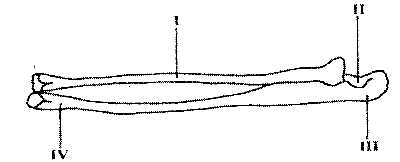
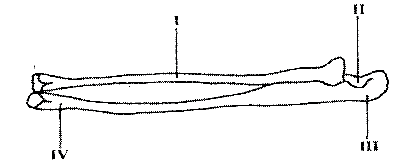
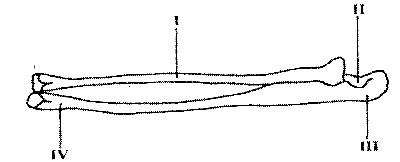
The diagram above illustrates a part of the human skeleton. It represents the bones of the
Sagot
(B)
lower arm
8
Which of the labelled parts of the diagram of the part of the human skeleton articulates with the head of the trochlea to form a hinge joint?
Sagot
(B)
II
9
The diagram above illustrates a part of the human skeleton. The labelled part that provides surface for the attachment of the triceps is
Sagot
(C)
III
10
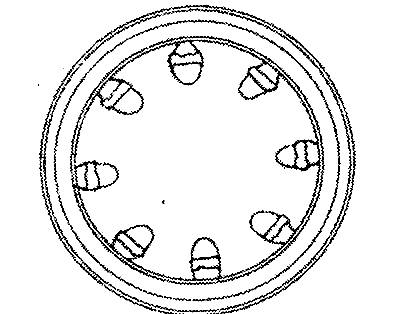
The diagram above illustrates the transverse section of a
Sagot
(C)
dicotyledonous stem
11
Which of the following actions does not occur during exhalation in man?
Sagot
(B)
Diaphragm flattens
12
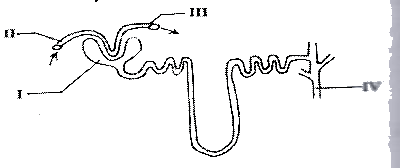
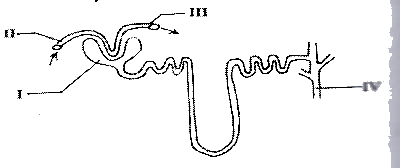
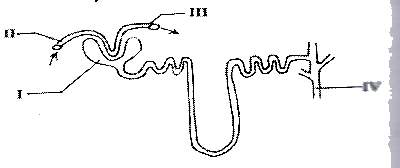
The diagram above is an illustration of the urinary tubule in a mammal. Which of the following substances is found in the part labelled II only?
Sagot
(C)
Urea
13
The diagram above is an illustration of the urinary tubule in a mammal. The part which contains lowest concentration of urea is labelled
Sagot
(C)
III
14
The diagram above is an illustration of the urinary tubule in a mammal. Which of the following substances is greater in concentration in the part labelled IV when compared to that part labelled I?
Sagot
(C)
Urea
15
Deamination of amino acids in the liver produces
Sagot
(D)
urea
16
Which of the following glands also serves as an exocrine gland?
Sagot
(B)
Pancreas
17
Which of the following sequences is the correct route of the transmission of impulses along a reflex arc?
When viewing an object that is close to the human eye, the
Sagot
(D)
eye lens becomes fat
19
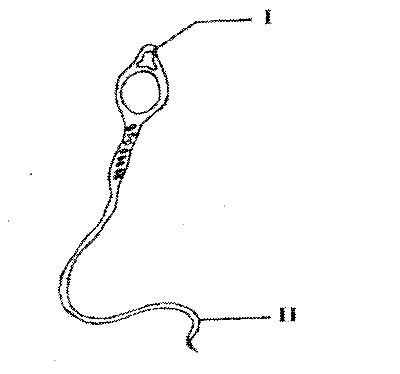
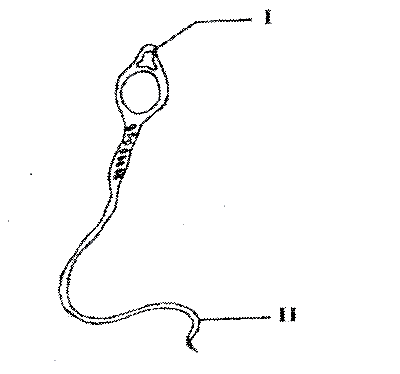
The diagram above is an illustration of the human sperm. The part labelled I is the
Sagot
(A)
acrosome
20
In the diagram of the human sperm above, the function of the part labelled II is to
Sagot
(C)
help the sperm to swim forward
21
Which of the following types of placentation is not common amongst syncarpous pistils?
Sagot
(A)
Marginal
22
The complex energy-rich organic matter which living organisms need for life is
Sagot
(C)
food
23
Which of the following processes are associated with photosynthesis? I. Energy from sunlight is absorbed II. Carbon dioxide is evolved III. Oxygen is given off IV. Glucose is synthesized
Sagot
(C)
I, III and IV only
24
Which of the following function is associated with calcium in plants? Formation of
Sagot
(A)
cell wall
25
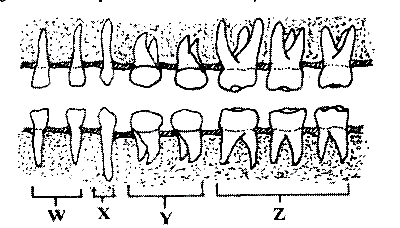
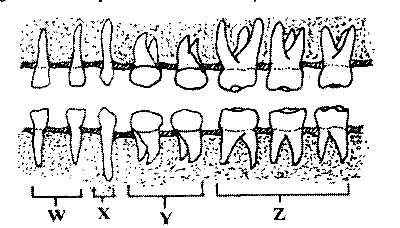
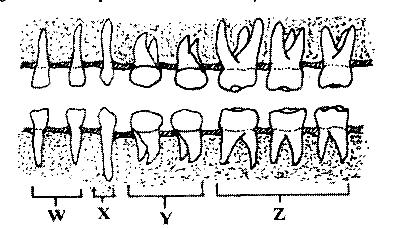
The diagram above shows the dentition of an organism. What organism is this?
Sagot
(D)
man
26
The diagrams below show the dentition of an organism. The function of the teeth labelled X is for
Sagot
(C)
tearing and grasping
27
The teeth which are absent in the young of the organism whose dentition is shown above is labelled
Sagot
(D)
Z
28
The number of individuals that the environment can support over a long period of time is its
Sagot
(C)
population capacity
29
A good site for secondary succession would be
Sagot
(C)
a land that has just had forest fire
30
A population which exceeds its carrying capacity and then collapses is represented graphically by a
Sagot
(A)
bell-shaped curve
31
The natural dwelling place of an organism is called its
Sagot
(B)
habitat
32
Which of the following ecological factors will result in food shortage?
Sagot
(A)
Drought
33
Soil permeability refers to
Sagot
(A)
how easily water passes through the soil
34
Which of the following groups of organisms do not have members that can be called autotrophs?
Sagot
(D)
Fungi
35
Which of the following pyramids gives the most accurate picture of the relationships between at the various trophic levels in a food chain? A pyramid of
Sagot
(B)
energy
36
Which of the following statements is not associated with pyramids of energy?
Sagot
(B)
Comparisons of pyramids for different ecosystems can be made
37
Which of the following materials is not easily biodegradable?
Sagot
(A)
Polythene bag
38
Which of the following pairs of organisms is in a mutualistic relationship?
Sagot
(B)
Hermit crab and Sea anemone
39
The establishment of game reserves and parks is a method of
Sagot
(A)
conserving natural resources
40
Which of the following practices is not used in conserving water?
Sagot
(C)
Deforestation
41
Which of the following resources cannot be renewed?
Sagot
(B)
Petroleum
42
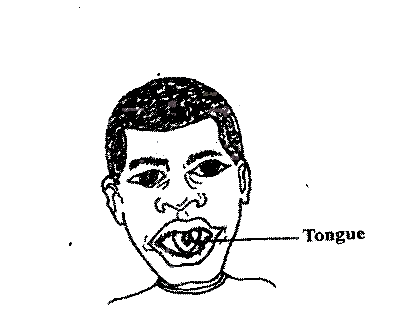
The type of variation illustrated above is
Sagot
(B)
discontinuous variation
43
Which of the following characters is not a morphological variation?
Sagot
(D)
tongue rolling
44
An apple plant can produce sexually and asexually and it has 40 chromosomes in its leaf cells. How many chromosomes would be in each gamete and somatic cell?
Sagot
(C)
20 chromosomes in the gametes and 40 in the somatic cells
45
Assuming that A is the gene for normal skin color and is dominant, while a is the gene for albinism and its recessive, what is the likely genotype of the couple which had 50% normal and 50% albino offspring?