WAEC - Chemistry (2015)
1
The negatively charged particle in an atom is the
2
How many orbits are contained in an atom with atomic number 13?
3
The Van der waals' forces are dominant intermolecular forces in_______?
4
The compound formed between 14X and 16Y is _______?
5
The shape of a molecule of water is _______?
6
A metallic ion Z\(^{2+}\) with an inert gas structure contains 18 electrons. How many protons are contained in this ion?
7
Which of the following pairs of elements forms amphoteric oxides?
8
Which of the following pairs of compounds belongs to the same homologous series?
9
The following transition metal ions would be coloured in aqueous solution except________?
10
The gas given off when ethanol reacts with sodium is
11
Which of the following halogens is solid at room temperature?
12
The alkaline earth metals have similar chemical properties because________?
Jibu(C)
They have the same number of valence electrons
13
The number of unpaired electrons in an atom of an element 8Q is _______?
14
The bond formed when ammonia reacts with hydrogen ion to form ammonium ion is
15
To which group and period respectively does an element with 15 electrons belong?
16
The shape of a graphite crystal is
17
Which of the following oxides is ionic?
18
Which of the following substances when boiled with aqueous solution of sodium hydroxide would be hydrolyzed?
i. Protein ii. Fat iii. Polythene
19
Which of the following trioxonitrate(V) salts would decompose on heating to form a metal?
20
Consider the following reaction equation:
C2H4(g) + 3O2(g) \(\to\) 2CO2(g) + 2H2O(g)
The volume of CO2(g) produced at s.t.p when 0.05 moles of C2H4(g) was burnt in O2(g) is
[Molar Volume of gas = 22.4dm3
21
The number of oxygen molecules present in 16.0g of the gas is ______?
[Avogadro's number = 6.02 x 10²³]
22
Consider the following reaction equation:
SO42-(aq) + 2H+(aq) + ye- \(\to\) SO42-(aq) + H2O(1).
The value of y in the equation is
23
The general gas equation was deprived from______?
Jibu(C)
Boyle's and Charles' laws
24
The vapour pressure of a liquid depends on:
I. Temperature II. rate of condensation III. Cohesive forces holding the particles together.
25
Which of the following gases will diffuse most rapidly?
[H = 1.00, C = 12.0, O = 16.0, S = 32.0, Cl = 35.5]
26
When a reaction is endothermic,
Jibu(C)
Heat content of reactants is less than the heat content of product
27
Which of the following statements about intermolecular distances and cohesive forces between gas is correct? They are
28
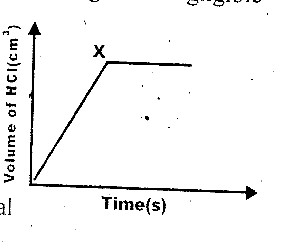
The following diagram illustrates the rate curve that was obtained when Mg reacted with excess dilute HCl.
The diagram became horizontal at X because
29
An example of an acid salt is
30
Which of the following oxides can be reduced by hydrogen?
31
Solubility is practically applied in
32
Which of the following compounds is the least soluble in water?
33
A substance which dissolves readily in organic solvent would
34
A change in the temperature of a saturated solution disturbs the equilibrium between the
Jibu(C)
Dissolved solute and the undissolved solute
35
Which of the following statements about an electrochemical cell is correct? Oxidation occurs
36
Consider the following reaction equation:
CuO(s) + H2(g) \(\to\) Cu(s) + H2O(1)
Which substance is oxidized?
37
Which of the following metals is the strongest reducing agent?
38
The complete hydrogenation of benzene gives
39
A compound has an empirical formular CH2O and molecular mass of 90.
[H = 1.00, C = 12.0, O = 16.0]
40
Which of the following reactions would take place when concentrated sodium hydroxide solution is added to palm oil?
41
Starch could be converted to glucose by the process of
42
Which of the following compounds is a secondary alkanol?
43
Which of the following substances is a heavy chemical?
44
Which of the following process does not take place in domestic water treatment?
45
A substance responsible for the sour taste of unripe orange is