Which if the following organisms is not classified as an animal?
Përgjigju
(C)
Euglena
2
An organism that operates at the cellular level of organization, carries out its physiological activities by
using its
Përgjigju
(B)
organelles
3
The organelle which eliminates water from the body of a protozoan is the
Përgjigju
(B)
contractile vacuole
4
Which of the following cell types has the least number of mitochondria?
Përgjigju
(B)
Cells of the cornified layer
5
A typical plant cell is mainly distinguished from an animal cell by the possession of
Përgjigju
(C)
chloroplast and cell wall
6
Which of the following characteristics do fungi share in common with animals?
Përgjigju
(C)
Storage of carbohydrates as glycogen
7
Which of the following processes involves diffusion?
Përgjigju
(D)
Absorption of digested food into the villi
8
The mechanism of opening and closing of stomata in plants is based on
Përgjigju
(B)
turgidity and flaccidity
9
In cellular respiration energy is made available to organisms by
Përgjigju
(B)
breaking off a phosphate group from ATP
10
Excretion in Paramecium sp. is by diffusion because
Përgjigju
(C)
it has a large surface area to volume ratio.
11
The axial skeleton is composed of the
Përgjigju
(A)
skull and vertebral column
12
The inorganic components of bone consist of
Përgjigju
(B)
magnesium, phosphorus and calcium
13
A pulse is best described as
Përgjigju
(A)
contraction of arteries to let out blood.
14
The following characteristics are associated with the mammalian lungs except
Përgjigju
(B)
expandable lungs
15
The excretory system in mammals consists of the following parts except
Përgjigju
(C)
two bladders
16
The organ that receives reduced flow of blood during vigorous exercise is the
Përgjigju
(A)
brain
17
The ear pinna is strengthened by
Përgjigju
(B)
cartilage
18
The relationship between the retina and the brain is similar to that between the
Përgjigju
(B)
cochlea and the brain.
19
Which of the following statements about the development of the foetus is not correct?
Përgjigju
(A)
The circulatory system of the foetus is directly connected to the maternal blood vessels
20
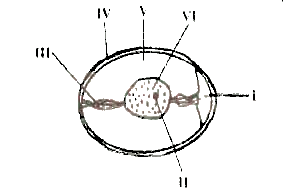
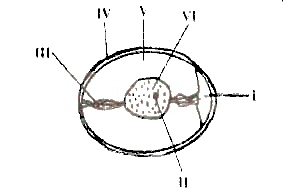
The parts that supply food and water to the developing embryo are labelled
Përgjigju
(C)
V and VI
21
The part labelled III is the
Përgjigju
(B)
chalaza
22
Which of the following statements ls true about transpiration? It is the
Përgjigju
(A)
loss of water in the form of vapour from the surface of the’ leaf
23
Transportation of water in the xylem tissue involves the following except
Përgjigju
(D)
translocation
24
The following are the major reasons why the butterfly lays eggs under the surface of a leaf except to
Përgjigju
(D)
camouflage the eggs
25
In which of the following organic compounds is the hydrogen-oxygen ratio equal to 2:1?
Përgjigju
(B)
Carbohydrates
26
A man suffering from obesity must avoid meals containing
Përgjigju
(A)
margarine and butter
27
In testing for starch in a leaf, the leaf is first boiled in water for about a minute so that the
Përgjigju
(B)
cells are killed
28
Which of the following food substances is incorrectly linked to its enzyme?
Përgjigju
(C)
Sucrose - pepsin
29
Which of the following pH values is the best for the action of the enzymes - renin and pepsin in the
stomach?
Përgjigju
(A)
pH2
30
The bacterium in a mutualistic association with legumes converts
Përgjigju
(D)
nitrites to nitrates
31
An herbivore cannot feed on a piece of meat because it has no
Përgjigju
(B)
canines to tear up the meat
32
In a particular habitat the role of an organism is referred to as its
Përgjigju
(C)
niche
33
The distribution of organisms in a fresh water habitat like a stream or pond is determined by the following
factors except
Përgjigju
(B)
pH of the soil
34
The speed of wind is measured using the
Përgjigju
(B)
anemometer
35
Which of the following is a biotic component of an ecosystem?
Përgjigju
(D)
Fungi
36
A moss plant can withstand drought by means of its
Përgjigju
(A)
spores
37
Which of the following factors is the main problem facing xerophytic plants?
Përgjigju
(D)
Lack of adequate water
38
The following are greenhouse gases except
Përgjigju
(D)
oxygen
39
Rural-urban migration in developing countries can be prevented by
Përgjigju
(D)
even distribution of facilities in both regions
40
Muscles are attached to bones by means of
Përgjigju
(A)
tendons
41
In a population, food shortage may lead to
Përgjigju
(C)
intra-specific competition
42
The following effects are associated with deforestation except
Përgjigju
(D)
increase in rainfall
43
The main reason for the conservation of wildlife is to
Përgjigju
(D)
save some species from extinction.
44
Which of the following is an example of variation?
Përgjigju
(B)
Tongue rolling
45
The parameters of size, height, weight and colour in a population of living things are examples of
Përgjigju
(C)
continuous variations
46
Fingerprints are useful in crime detection because
Përgjigju
(C)
no two people have the same fingerprint
47
A person with blood group, O can be given blood from persons who have blood belonging to
Përgjigju
(A)
group O only
48
A man heterozygous for albino gene marries a woman who is also heterozygous for the gene. Both have normal skin colour. The probability that they will have an albino child is
Përgjigju
(B)
1/4
49
Which of the following statements about heredity is not true? In heredity the traits are
Përgjigju
(C)
always transmitted by one parent
50
An example of a saprophytic relationship is a / an
Përgjigju
(B)
mushroom growing on decaying vegetation
51
In artificial selection, individuals without desirable traits may be prevented from mating by
Përgjigju
(B)
sterilization
52
In a family of eight (8) all the children are girls Which of the following reasons correctly explains this?
Përgjigju
(D)
The X component of the man’s sex chromosome was always involved.
53
Which of the following statements is correct about the structure of a chromosome? A chromosome consists of
Përgjigju
(A)
two chromatids joined at the centromere
54
Mr. Andrew, his wife and child belong to blood groups A, B and O respectively. The genotypes of both parents are
Përgjigju
(D)
IA IO and IB IO.
55
What would be the phenotypic ratio of the offspring of a cross between a heterozygous dominant parent and a double recessive parent?