The Makkan suwar lay emphasis on oneness of ‘Allāh because
Odpoveď
(C)
the pre-Islamic Makkans worshipped many gods
3
The uniqueness of the Glorious Qur’ān, according to Q.39:28, lies in the fact that it is
Odpoveď
(D)
reveled in Arabic
4
One of the sahābah considered most knowledgeable in Tafsīr was
Odpoveď
(C)
Abdullah b. cAbbās “Ibn Abbas (Abdullahi) was considered most knowledgeable in Tafsir among the scholars (Sahabah).
5
The contents of sūraℎ al-fatihah can be summed up to mean that
Odpoveď
(C)
man must worship ‘Allāh and seek His help
6
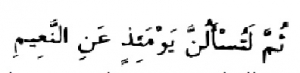
According to the verse above, man shall
Odpoveď
(D)
be questioned about the joy he indulged in “Then on that Day, you shall be asked about the delight (you indulged in, in this world)”.
7
One of the lessons taught in sūrah 'al- Mā'un is that
Odpoveď
(D)
a good Muslim should always be honest in his works and worship.
8
The theme of sūrah al-Inshirāh is that
Odpoveď
(D)
‘Allāh always provides a solution to any problem “Verily along with every hardship is relief (5). “Verily along with every hardship is relief (6). (Q. 94:5-6).
9
The creation of man in orderly proportion is described in sūrah
Odpoveď
(B)
at-tīn “Verily we created man in the best stature (mould)” Q. 95:4.
10
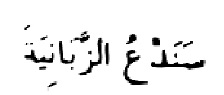
Az-zabāniyah in the verse above refers to the
Odpoveď
(B)
angels of punishment
11
Musnad as a work on Hadīth is credited to
Odpoveď
(B)
Ibn Hambal “Ahmad bin Hambali was the founder of Hambali School of Law, one of the Sunning Schools. His work on Hadith is known as MUSNAD
12
According to Hadītℎ 6 of an-Nawawi, it is better to avoid ambiguous matters in order to
Odpoveď
(C)
protect one’s religion He who is on his guard with respect to the ambiguous things keeps his religion and his honour clean…”
13
The number of lashes prescribed for the consumption of alcohol is
Odpoveď
(C)
eighty “Islam prescribes eighty lashes of cane, as a penalty for the consumption of alcohol. “Sanan Abu Daud, Kitaab. Hudud 35-37.
14
Q.17:26-27 warns Muslims not to squander their wealth as squanderers are brothers of the
Odpoveď
(A)
evil ones “…. But spend not wastefully (your wealth) in the manner of a spendthrift…” Q. 17:27.
15
Al-cawrah for a man is from the
Odpoveď
(B)
navel to the knee
16
Q.24:30 enjoins Muslims to
Odpoveď
(D)
lower their gaze. “Tell the believing man to lower their gaze…” Q. 24:30.
17
According to the Prophet (S.A.W), he who betrays trust in regarded as having
Odpoveď
(D)
neither faith nor religion.
18
‘Allāℎ’s existence is often demonstrated in the Glorious Qur’ān by reference to his
Odpoveď
(A)
creation
19
The messenger of ‘Allāℎ sent to the people of Thamūd was
Odpoveď
(D)
Salih (A.S).
20
One of the revealed books ‘Allāh promised to protect against distortion is
Odpoveď
(D)
al-Furqān. “Inna Nahnu Nazzalna dhikr wa inna lahu lah a fidhu~n”
21
Yawmuddīn refers to the day of
Odpoveď
(B)
Judgment “Malik Yaumiddeen” (The owner of the Day of Judgement) Q. 1:3.
22
The field of study dealing with Ibādar and Muāmalār is known as
Odpoveď
(A)
Fiqh The meaning of Figh is understanding comprehension knowledge and Jurisprudence in Islam” A jurist in Islam is called Faq i ~ h while Jurisprudence is called Fiqh.
23
Taking the ritual bath for Friday prayers is
Odpoveď
(B)
sunnah
24
The number of takbir observed during salah al-Janāzah is
Odpoveď
(C)
four “Sal a tul-Jamazah is a funeral prayer and it is Fardu Kifayah. It consists of two parts: 1. Four Takibirah. 2. Qayamah
25
The jamrat that pilgrims are expected to stone on the 10th day of Dhul hijjah is
Odpoveď
(A)
al-Aqabah
26
The next place for a Muslim to spend the night after ‘Arafat is
Odpoveď
(D)
Muzdalifah.
27
A Muslim who cannot marry for genuine reasons is advised to
Odpoveď
(D)
fast periodically for self-discipline
28
The ill-treatment of a wife in Islam is called
Odpoveď
(B)
‘idrār “Idr a r means ill treatment of wife”
29
Q.33:35 emphasizes the
Odpoveď
(A)
equality of men and women“Verily the Muslims (those who submit to Allah in Islam) men and women…”
30
If a husband divorces his wife before the consumption of the marriage, it is considered
Odpoveď
(B)
irrevocable
31
If a husband divorces his wife before the consumption of the marriage, it is considered
Odpoveď
(B)
irrevocable
32
A woman who loses her husband while undergoing an ‘iddah of revocable divorce changes to ‘iddah
Odpoveď
(A)
al-wafāt
33
Where the father is the only heir who survives his son, he will inherit
Odpoveď
(D)
the whole of his property
34
In an Islamic state, the right to pardon a murdered lies with the
Odpoveď
(D)
courts
35
‘People come in search of knowledge, but knowledge does not seek people.’
The statement above was made to Caliph Harūn ar-Rashīd by