A group of closely related organisms capable of interbreeding to produce fertile offspring are known as members of a
Răspuns
(D)
species
2
Viruses are economically important because they?
Răspuns
(C)
cause diseases in plants and animals
3
A beaker of pond water containing few specimens of Euglena was placed in a dark room for two weeks. At the end of this period, the specimens of Euglena were still alive because they were
Răspuns
(A)
able to carry out holozoic nutrition.
4
The cytoplasm of the cell is considered a very important component because it
Răspuns
(B)
suspends all cell organelles.
5
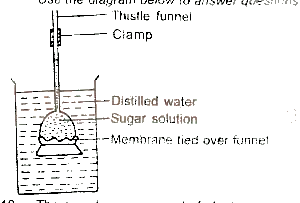
After an hour, the level of water in the thistle funnel will
Răspuns
(A)
rise
6
The experiment above is used to demonstrate the process of
Răspuns
(D)
osmosis
7
In plant cells the role of the membrane is played by the
Răspuns
(B)
cell wall
8
Red blood cells were found to have burst open after being placed in distilled water for an hour. This phenomenon is known as
Răspuns
(C)
haemolysis
9
The curvature movement of plants in response to the stimulus of water is called
Răspuns
(A)
hydrotropism
10
Two organelles directly involved in mitotic cell division are
Răspuns
(D)
nucleus and centriole
11
The following statements about mitotic cell division are correct except that
Răspuns
(A)
it occurs only in young cells
12
The longest bone in the body is the
Răspuns
(B)
femur
13
Which of the following structures is not a skeletal material?
Răspuns
(D)
Muscle
14
The reason why the flow of blood through the capillaries is very slow is
Răspuns
(D)
to allow adequate time for exchange of materials.
15
Which of the following features is not characteristic of arteries? Arteries
Răspuns
(A)
possess valves at intervals throughout their length
16
A group of rats placed in an air-tight box for some hours died because they
Răspuns
(D)
used up the available oxygen
17
Which of the following organisms have kidney as their excretory organ?
Răspuns
(A)
Fishes, amphibians, birds, man.
18
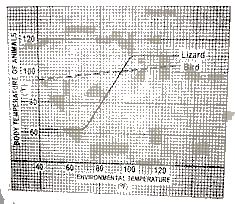
Which of the statements below is valid?
Răspuns
(C)
The body temperature of the bird remained constant despite changes in environmental temperature
19
What physiological term can he used to
describe the regulation of the body
temperature of the lizard? '
Răspuns
(C)
Poikilothermy
20
The reason why hospitals use saline solutions as drip instead of water is
Răspuns
(C)
to maintain the composition of the body fluids
21
The part of the ear which contains nerve cells sensitive to sound vibrations is the
Răspuns
(A)
cochlea
22
Spectacles with convex lenses correct long-sightedness by
Răspuns
(A)
converging the light rays before they enter the eye.
23
A seed of a flowering plant can best be described as
Răspuns
(B)
the developed ovule
24
Which of the following processes removes carbon from the atmosphere?
Răspuns
(B)
Photosynthesis
25
Which of the following cycles involves the process of precipitation and transpiration?
Răspuns
(A)
Water cycle
26
The mesophyll layer of a leaf consists of
Răspuns
(D)
photosynthetic parenchyma cells.
27
Which of the following treatments would increase the rate of transpiration in a potted plant?
Răspuns
(B)
Placing it under a fan in a room
28
Pepsin is secreted as an inactive precursor called pepsinogen because
Răspuns
(C)
pepsin is a proteolytic enzyme and might attack the stomach tissues
29
An organism whose source of carbon is inorganic is likely to be a/an
Răspuns
(B)
autotrophic organism
30
Which of the following organisms is an endoparasite?
Răspuns
(C)
Ascaris
31
Which of the following statements about ecosystems is false?
Răspuns
(A)
All the energy entering the ecosystem is passed on to decomposers
32
What is the critical limiting factor for plants below the photic zone is an aquatic ecosystem?
Răspuns
(C)
Intensity of light
33
Which of the following instruments is used to estimate the number of plants in a habitat?
Răspuns
(C)
Quadrat
34
Which of the following statements is true about sandy soil? It
Răspuns
(B)
is light and easy to dig
35
Which of the following organisms is a primary consumer?
Răspuns
(B)
Sheep
36
P → Q → R → S → T
he organism designated P in the food chain above is normally sustained by energy from
Răspuns
(A)
sunlight
37
P → Q → R → S → T
Which of the following statements best describes the organism designated R? It
Răspuns
(D)
is a secondary consumer
38
Food chains are relatively short because
Răspuns
(C)
of energy loss at each trophic level
39
which of the following organisms does not show colour adaptation to its environment?
Răspuns
(B)
Earthworm
40
Most tropical plants shed their leaves during dry weather conditions in order to
Răspuns
(B)
conserve water
41
Which of the following features is not an adaptation of plants to aquatic habitat?
Răspuns
(D)
Hairy structures on the leaves to reduce water loss
42
The following habitats can be used in the study of succession except
Răspuns
(D)
a well cultivated land
43
Population growth rate may be defined as the
Răspuns
(D)
net rate of natality and mortality in the habitat over a period.
44
In ecological succession, since Iichens grow on bare rock, they are considered to be
Răspuns
(B)
pioneer organisms
45
Which of the following factors will most likely lead to overcrowding within a population?
Răspuns
(A)
Absence of predators
46
A species whose populations has become so small that it may become extinct if not protected is a/an
Răspuns
(C)
endangered species
47
Which of the following practices does not contribute to the preservation and improvement of the environment?
Răspuns
(D)
Overgrazing
48
Variation is important in human life and can be used for the following activities except
Răspuns
(B)
population distribution
49
An example of continuous variation is
Răspuns
(D)
body size
50
The outward appearance or an organism is referred to as
Răspuns
(A)
phenotype
51
The allele responsible for sickle-cell anaemia first appeared in the tropical and subtropical regions of Asia, the Middle
East and Africa. It entered the United States of America when individuals were forcibly brought over from Africa. In micro-
evolutionary terms this is an example of
Răspuns
(B)
gene flow
52
Which of the following diseases is not hereditary?
Răspuns
(B)
Scabies
53
The immediate product of meiosis in flowering plants is the
Răspuns
(D)
pollen grain
54
DNA in eukaryotic cells is contained in the
Răspuns
(B)
nucleus
55
A man who is heterozygous for the disease haemophilia marries a woman who is double recessive for haemophilia. What percentage of their offspring would have the disease?