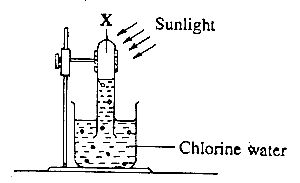
The raw materials used for the smelting of iron ore in a furnace is
Răspuns
(B)
CaCO3
2
On heating, which of the following compounds will decompose to the free metal, nitrogen (IV) oxide and oxygen?
Răspuns
(C)
AgNO3
3
The group IA metals are not found free in nature because they
Răspuns
(A)
are very reactive and unstable
4
Carbon exist naturally in the combined state as?
Răspuns
(D)
wood
5
The efficiency of a solid catalyst to increase reaction rates depends on its
Răspuns
(A)
surface area
6
Dynamic equilibrium describes a situation where
Răspuns
(C)
both forward and reverse reactions proceed at the same rate
7
The ion that will give a white precipitate with aqueous NaOH and soluble in excess of the base is
Răspuns
(C)
Zn2+
8
Which of the following pairs of substance will react further with oxygen to form a higher oxide?
Răspuns
(D)
SO2 and NO
9
The characteristic colour of the flame shown when a copper salt moistened with concentrated hydrochloric acid on a platinum wire is put on bunsen burner is
Răspuns
(B)
green
10
In the industrial production of H2 from natural gas the CO2 produced along with the H2 is removed by
Răspuns
(A)
washing under pressure
11
The sulphide which is insoluble in dilute hydrochloric acid is
Răspuns
(B)
CuS
12
Which of the following typically represents a photochemical reaction?
Răspuns
(D)
Conversion of silver halides to grey metallic silver
13
The gas obtained as a product of anaerobic action on organic matter buried in the earth is?
Răspuns
(B)
methane
14
Nigerian crude oil is described as light crude because of its
Răspuns
(A)
low sulphur content
15
An example of aliphatic unsaturated hydrocarbon is
Răspuns
(C)
propene
16
Which of the following has an isomer?
Răspuns
(C)
C4H10
17
CH3 - CH2 - C≡CH
The hybridization in the compound above is
Răspuns
(D)
sp3 and sp
18
One mole of a hydrocarbon contains 36g of carbon and its vapour density is 20. The structure of the hydrocarbon is
Răspuns
(A)
CH3C ≡ CH
19
An emulsion may be produced by shaking a detergent solution with
Răspuns
(C)
palm oil
20
The products of the combustion of candle wax are?
Răspuns
(C)
carbon (IV) oxide and water
21
When 50cm\(^3\) of a saturated solution of sugar of molar mass 342 g at 40\(^o\)C was evaporated to dryness, 34.2g of dry solid was obtained. The solubility of sugar at 40\(^o\)C is
Răspuns
(A)
2.0 mol dm-3
22
Which of the following results in the fall of acid rain?
Răspuns
(C)
Oxides of sulphur
23
Water has the ability to dissolve almost all substance because its molecules has a structure with
Răspuns
(B)
one positive end and one negative end
24
When a crystal was added to the clear solution of its salt, the crystal did not dissolve and the solution remained unchanged. This showed that the solution was
Răspuns
(D)
saturated
25
A particle that contains 11 protons, 12 neutrons and 10 electrons is probably a
Răspuns
(B)
metallic ion
26
A difference between chemical and physical change is that in a chemical change
Răspuns
(D)
a new substance is formed
27
The volume of 2.5 moles of oxygen at s.t.p is
[Molar volume of a gas at s.t.p = 22.4 dm3]
Răspuns
(D)
56.0 dm3
28
Nuclear fission involves the splitting of a heavy element into two nuclei of
Răspuns
(A)
nearly equal masses with a release of energy and radiation
29
What is the molar mass of a substance, if 0.4 mole of the substance has a mass of 25.0g?
Răspuns
(A)
62.5 g
30
The element with the electron configuration 1S\(^2\)2S\(^2\)2P\(^3\) is
Răspuns
(D)
nitrogen
31
A decrease in atomic size and an increase in nuclear charge across a period lead to
Răspuns
(C)
a decrease in electropositivity
32
The order in which a mixture of sand, ammonium chloride and sodium chloride can be separated is
If 30cm\(^3\) of gas at 50\(^0\)C is warmed to 80\(^0\)C at a fixed pressure, the fractional increase in volume is
Răspuns
(B)
0.093
35
2C\(_2\)H\(_2\)(g) + 5O\(_2\)(g) → 4CO\(_2\)(g) + 2H\(_2\)O(g)
In the reaction above, the mass of carbon(IV)oxide produced on burning 78 g of ethyne is
[C =12, O = 16, H = 1]
Răspuns
(A)
264 g
36
The ion that can be used as an oxidizing agent is
Răspuns
(C)
ClO-
37
H\(_2\)(g) + Br\(_2\)(g) → 2HBr(g)
The above reaction is carried out at 25\(^0\)C. ΔH is -72 kJ mol-1 and ΔS is - 106 J mol-1K-1, the reaction will?
Răspuns
(B)
proceed spontaneously at the given temperature
38
Zinc and carbon rods are used as anode and cathode respectively in a
Răspuns
(A)
Leclanche cell
39
The solution that will conduct the highest amount of electricity is?
Răspuns
(B)
2.0 mol dm-3 of hydrochloric acid
40
In which of the following is the oxidation number of sulphur equal to - 2?
Răspuns
(C)
H2S
41
In the electrolysis of CuSO\(_4\)(g) using platinum electrodes, the reaction at the anode is
Răspuns
(B)
4OH- + 4e- → 2H2O + O2
42
Na\(_2\)CO\(_3\)(g) + 2HCl(aq) → 2NaCl(aq) + H\(_2\)O(l) + CO\(_2\)(g)
How many moles of sodium trioxocarbonate (IV) are there in a 25 cm\(^3\) solution which required 10cm\(^3\) of 0.05 mol dm\(^3\) hydrochloric acid solution to neutralize it?
Răspuns
(C)
0.010 mole`
43
If the heat of combustion of hydrogen is -285.8kJ,
What is the heat of formation of water?
Răspuns
(C)
-285.8 kJ
44
5SO\(_2\)(g) + 2KMnO\(_4\)(aq) + 2H\(_2\)O(l) → K\(_2\)SO\(_4\) + 2MnSO\(_4\)(aq) + 2H\(_2\)SO\(_4\)(aq)
In the reaction above, the products give a