
JAMB - Chemistry (2025 - No. 76)
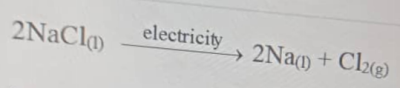
Sodium in the above reaction is produced by
Explanation
The production of sodium metal and chlorine gas from molten sodium chloride (NaCl) using electricity is an industrial process known as the Downs process. In this process, molten NaCl undergoes electrolysis in a specialized Downs cell, where the Na⁺ ions are reduced to liquid sodium at the cathode, and Cl⁻ ions are oxidized to chlorine gas at the anode.
A. Browning process: There is no widely recognized industrial process by this name for sodium production.
B. Chlor process: This likely refers to the chlor-alkali process, which is the electrolysis of aqueous sodium chloride (brine) to produce chlorine, hydrogen, and sodium hydroxide (NaOH), not pure sodium metal.
D. Bosch process: The Bosch process (often related to the Haber-Bosch process for ammonia synthesis) is not involved in the production of sodium and chlorine from NaCl.