Which of the following organisms contains Chlorophyll in its cells?
Responder
(C)
Euglena
2
Species are groups of organisms that
Responder
(C)
have similar features and can interbreed freely
3
A plant with short, vertical underground stem is a
Responder
(B)
corm
4
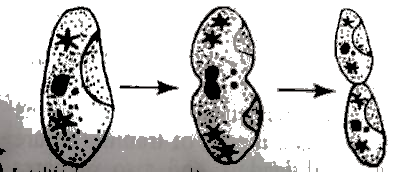
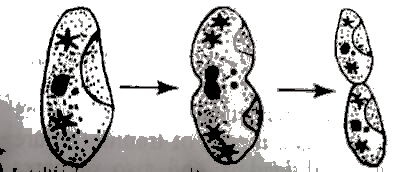
The diagram above is an illustration of a reproductive process in an organism. Study it and answer ques tions 4 and 5.
The type of reproduction illustrated is
Responder
(B)
binary fission
5
The illustrated organism is capable of reproducing by
Responder
(D)
sexual and asexual means
6
Which of the following organisms consists of unicellular cells joined to form a filament?
Responder
(B)
Spirogyra
7
The structure in the cell that controls the movement of substances in and out of the cell is the
Responder
(A)
cytoplasmic membrane
8
The bursting of a red blood cell placed in a hypotonic solution is called
Responder
(B)
haemolysis
9
The function of the root hair in plants is to
Responder
(A)
absorb soil water by the process of osmosis.
10
If a germinating seed is attached horizontally to a revolving klinostat, what would be the effect on the seedling after three days? The
Responder
(C)
plumule and radicle will not show any curvature.
11
The lumbar vertebra differs from the thoracic vertebra because it possesses a
Responder
(C)
thicker centrum.
12
Which of the following blood vessels carries oxygenated blood into the heart?
Responder
(C)
Pulmonary vein
13
Filtrates in the Bowman's capsule contain vitamins because
Responder
(A)
they have low molecular weight.
14
The structures that contain grey matter and white matter are found in the
Responder
(B)
nervous system.
15
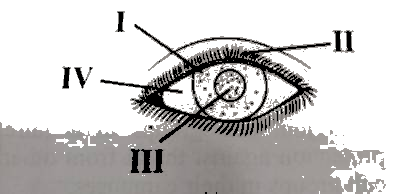
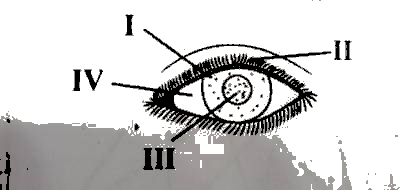
The diagram above is an illustration of sense organ in humans. Study it and answer questions 15 and 16.
The part that protects the organ is labelled
Responder
(B)
II
16
The part labelled III is the
Responder
(B)
pupil
17
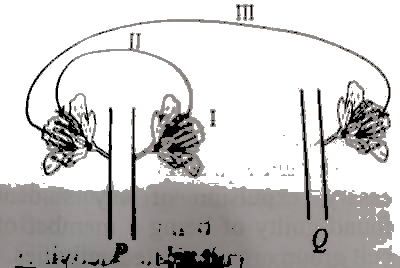
The diagram above is an illustration of two plants P and Q. Arrows I, II and III illustrate the transfer of pollen grains among flowers of plants P and Q. Studly it and answer questions 17 and 18.
The types of pollination illustrated as I,Il and III, respectively are
Responder
(B)
self, self and cross
18
The condition necessary for reproduction to occur between plants P and Q after pollination is that plants P and Q should be
Responder
(A)
of the same species.
19
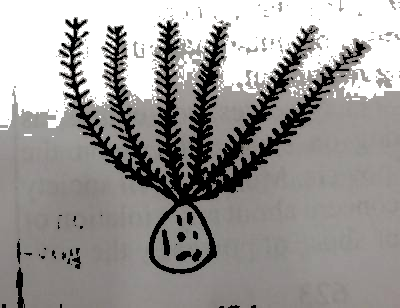
The diagram above illustrates a dry dehiscent fruit. Use it to answer questions 19 and 20.
The agent of dispersal of the fruit is
Responder
(D)
wind
20
The Parachute-like tuft of hairs developed from the
Responder
(D)
sepals
21
Which of the following events does not occur in the light reaction stage of photosynthesis?
Responder
(B)
Carbon (IV) oxide combines with hydrogen
22
The rate of photosynthesis decreases in a wilted herbaceous plant because the
Responder
(D)
amount of carbon dioxide entering the leaf decrease.
23
The element required for chlorophyll formation in plants is
Responder
(A)
Iron
24
The process of food digestion in mammals would
Responder
(D)
render food substances soluble and absorbable
25
Which of the following food substances would give a negative reaction with Benedict's reagent?
Responder
(D)
Sucrose
26
Sunlight is the major source of
Responder
(A)
Vitamin D
27
Discouraging the use of poison to kill fish in a large water body is a way of
Responder
(B)
conserving the fish species.
28
The pathway through which nutrient are replenished and circulated in an ecosystem is called a
Responder
(A)
cycle
29
The illustration below is a food chain. Study it and answer questions 29 and 30. Grasses → Grasshoppers → Lizards → Hawks
Which of the following statements is not correct about the food chain? The number of
Responder
(B)
grasses eaten by grasshoppers is fewer than the number of grasshoppers.
30
Grasses → Grasshoppers → Lizards → Hawks
If the individual species of organisms in the food chain are counted and arranged as a pyramid, the result would be a pyramid of
Responder
(A)
numbers
31
Which of the following gases is released during the decomposition of organic matter?
Responder
(C)
Hydrogen Sulphide
32
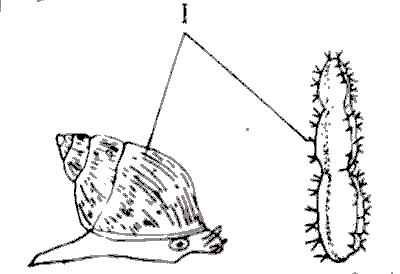
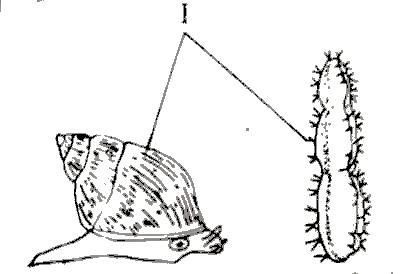
The diagrams above are the illustrations of organisms from different habitat. Study them and answer questions 32 and 33.
The structures labelled I are for
Responder
(C)
Physical defence
33
Habitats of the organisms respectively are
Responder
(D)
garden and desert
34
An environmental problem caused by Sulphur (IV) oxide is
Responder
(A)
acid rain
35
The phenomenon by which a farmland that is left to fallow for several years develops into a forest is called
Responder
(A)
Succession
36
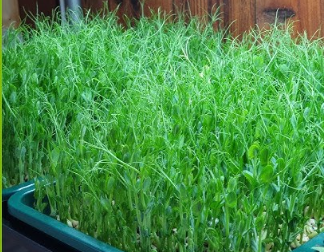
A farmer planted many seeds on a small piece of land. The plants that germinated are as shown above.
Which of the following effects would not be observed among the population of the plants?
Responder
(C)
Mutualistic relationship
37
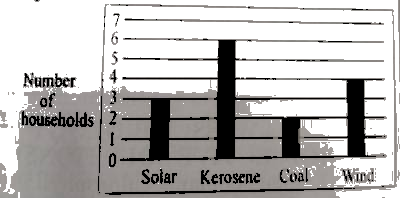
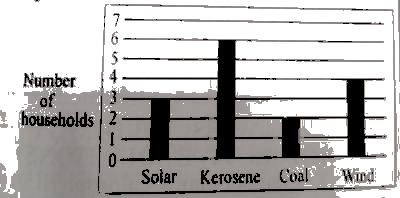
The bar chart above shows the data of sources of energy used for cooking in a community. Study it and answer questions 37 and 38.
The source of energy that is mostly used in the community is
Responder
(B)
Kerosene
38
The two sources of energy that would mostly lead to pollution in the community are
Responder
(C)
kerosene and coal
39
An individual found a strange bird that is tagged as an endangered specie. What should the individual do?
Responder
(C)
Return it to its natural habitat
40
Which of the following traits is not inheritable? Ability to
Responder
(D)
roll the eyeball
41
Which of the following statements is correct about the ABO blood group system?
Responder
(B)
Antibodies are located in the blood plasma
42
A woman with blood group A gives birth to a child with blood group O. Which of the following blood groups cannot belong to the father?
Responder
(C)
AB
43
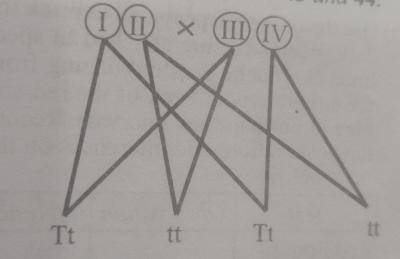
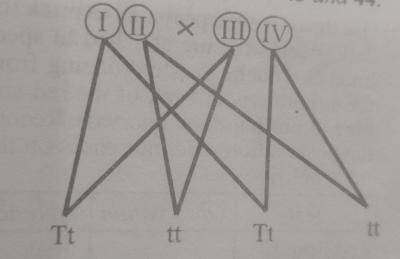
The diagram above is an illustration of genetic cross between two parents. The parental gametes I, II, III and IV gave rise to the offspring below. Study it and answer questions 43 and 44.
Gametes I, II, III and IV, respectively are
Responder
(B)
T, t, t, and t
44
Which of the following statements is correct about the cross?
Responder
(C)
The female is homozygous
45
The physical appearance of an organism is described as its