The branch of Biology that deals with the principles of classification of organisms is known as
Responder
(C)
taxonomy
2
Which of the following structures is a tissue
Responder
(B)
Blood
3
Which of the following cells are not regarded as specialized?
Responder
(D)
somatic cells
4
Which of the following pairs of cells carry out the same function?
Responder
(B)
Spermatozoan and ovum
5
If Amoeba is placed in a salt solution. the contractile vacuoles would
Responder
(C)
be formed less frequently
6
In which of the following habitats is Paramecium no found
Responder
(B)
Aquarium
7
The following processes are involved in water movement in the endodermis except
Responder
(D)
active transport
8
Cells that utilise a lot of energy are characterized by the presence of a large number of
Responder
(B)
mitochondria
9
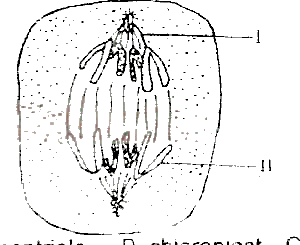
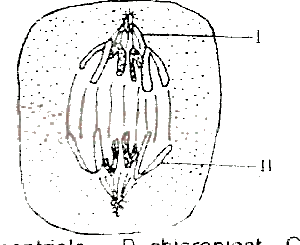
The part labelled II in the diagram is
Responder
(C)
chromatid
10
The part labelled I is called the
Responder
(D)
spindle
11
Secondary growth is brought about by the activities of the
Responder
(D)
vascular cambium and phellogen
12
A monocot root IS different from a dicot root by having
Responder
(C)
wide pith
13
Which of the following statements best describes haemoglobin? It is
Responder
(C)
an oxygen carrying pigment
14
Inhaled air is made warm and moist in the
Responder
(B)
nasal cavity
15
Which of the following structures is not involve in respiration?
Responder
(C)
Stomach
16
Filtrate in the Bowman’s capsule contains vitamins because
Responder
(C)
they have low molecular weight
17
ore sweat is produced during muscular exercise because
Responder
(C)
the temperature of the body rises
18
Which of the following neurons may not have myelin sheath?
Responder
(B)
Intermediate neurons
19
Which of the following is not an effector organ?
Responder
(C)
Nose bridge
20
During sexual reproduction in Paramecium, how many times does the zygote divide to produce eight nuclei?
Responder
(C)
3
21
The testes in male mammals descend into the scrotal sac because
Responder
(D)
they require a relatively low temperature
22
Some animals return to water bodies to reproduce because
Responder
(D)
the temperature on land is not suitable for the development of their embryos
23
Which of the following methods is appropriate for the cultivation of cassava?
Responder
(D)
Stem cutting
24
What will be the chromosome number of the hybrid of two varieties of a plant with 36 chromosomes in the endosperm cell?
Responder
(C)
35
25
Kreb’s cycle occurs in the
Responder
(A)
mitochondria
26
The process whereby electrons are emitted from chlorophyll and returned to it unchanged is known as?
Responder
(D)
cyclic photophorylatlion
27
Which of the following statements about photosynthesis is not true?
Responder
(A)
Plants can photosynthesize without an increase in dry weight
28
The removal of all the phloem tissues of the stem of a plant close to the root system for a long period of time is likely to
Responder
(D)
cause the p ant to wither and die
29
Which of the following groups of substances are not six-carbon compounds?
Responder
(D)
Pyruvate and cellulose
30
The conversion of glucose to starch in the leaf during the day principally
Responder
(C)
enables the leaf to store the starch
31
A purple colour was obtained when sodium hydroxide solution and a drop of copper sulphate solution were added to a food substance. The food substance is likely to be a
Responder
(C)
protein
32
Which of the following enzymes is active in the duodenum?
Responder
(C)
Trypsin
33
The following organisms are producers except
Responder
(B)
Mushroom
34
Which of the following structures produces the greatest variety of digestive enzymes?
Responder
(B)
Pancreas
35
The following are abiotic components of an ecosystem except
Responder
(C)
bacteria
36
Use the information on capture-recapture method to calculate the total number of organisms in a habitat.
First capture = 200
Second capture = 120
Number of organisms with mark in second capture = 40
The total number of organisms therefore is
Responder
(C)
600
37
Ecological investigation in a habitat includes the following procedures except
Responder
(C)
determining the genetic makeup of specimens
38
Which of the following substances when lost from the body of a mammal will not be returned to the ecosystem?
Responder
(C)
Heat energy
39
The rate of decomposition of organisms is faster in the tropical rain forest than in other biomes because
Responder
(C)
of abundance of water
40
A xerophyte conserves water by possession of the following features except
Responder
(C)
broad leaves
41
The falling off of leaves of deciduous trees is helpful to the plant because it
Responder
(A)
reduces the rate of transpiration
42
A sample of wet garden soil of known weigh was heated to constant weight. The loss of weight is due to loss of
Responder
(C)
water and organic matter
43
Assuming that a period of stable population size is followed by a period when natality increases by ten (1O) per cent and immigration increases by twenty (20) percent of population size. The population size will
Responder
(C)
begin to increase
44
Which of the following methods does not make water fit for drinking?
Responder
(C)
Distillation
45
Vaccination results in
Responder
(B)
production of antibodies which destroy toxins of germs
46
Leguminous crops are incorporated into crop rotation in order to
Responder
(B)
promote nitrogen fixation
47
Which of the following practices improves crop yield in a clayey soil? Addition of
Responder
(B)
lime and humus
48
Which of the following activities promotes forest conservation?
Responder
(C)
Afforestation
49
Which of the following statements is not true about continuous variation? It
Responder
(D)
is usually controlled by one or two pair(s) of genes
50
Acquired characters are
Responder
(C)
caused by the environment
51
Differences in characteristics observed between individuals of the same species is known as
Responder
(D)
variation
52
Which of the following statements best describes protein synthesis?
Responder
(A)
DNA is directly involved in translation
53
If a person has two alleles of the sickle cell anaemia gene, the person
Responder
(C)
has the disease
54
What is the probability? of a man of blood group AB married to a woman of blood group O producing a child of blood group O?
Responder
(A)
0%
55
A man with blood group It IA IA is married to a woman with blood group IA IO. The blood group of their son is likely to be