JEE MAIN - Physics (2009)
- 1
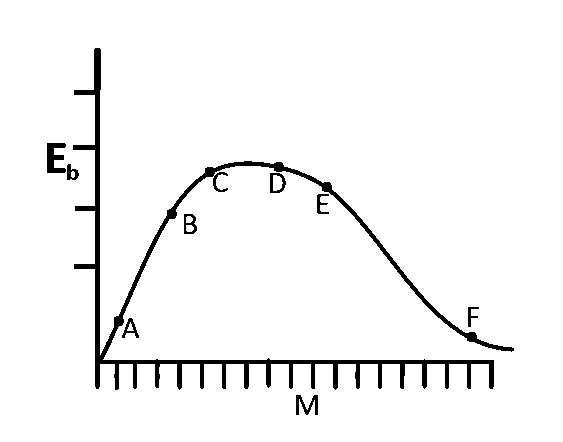
The above is a plot of binding energy per nucleon $${E_b},$$ against the nuclear mass $$M;A,B,C,D,E,F$$ correspond to different nuclei. Consider four reactions :
$$\eqalign{ & \left( i \right)\,\,\,\,\,\,\,\,\,\,A + B \to C + \varepsilon \,\,\,\,\,\,\,\,\,\,\left( {ii} \right)\,\,\,\,\,\,\,\,\,\,C \to A + B + \varepsilon \,\,\,\,\,\,\,\,\,\, \cr & \left( {iii} \right)\,\,\,\,\,\,D + E \to F + \varepsilon \,\,\,\,\,\,\,\,\,\,\left( {iv} \right)\,\,\,\,\,\,\,\,\,F \to D + E + \varepsilon ,\,\,\,\,\,\,\,\,\,\, \cr} $$where $$\varepsilon $$ is the energy released? In which reactions is $$\varepsilon $$ positive?
Responder(D)$$(i)$$ and $$(iv)$$ - 4A transparent solid cylindrical rod has a refractive index of $${2 \over {\sqrt 3 }}.$$ It is surrounded by air. A light ray is incident at the mid-point of one end of the rod as shown in the figure.
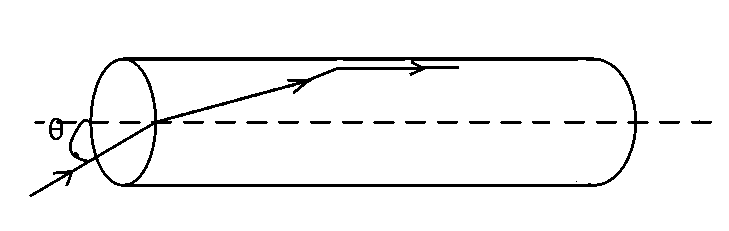
The incident angle $$\theta $$ for which the light ray grazes along the wall of the rod is :
Responder(C)$${\sin ^{ - 1}}\left( {{1 \over {\sqrt 3 }}} \right)$$ - 7A transparent solid cylindrical rod has a refractive index of $${2 \over {\sqrt 3 }}.$$ It is surrounded by air. A light ray is incident at the mid-point of one end of the rod as shown in the figure.
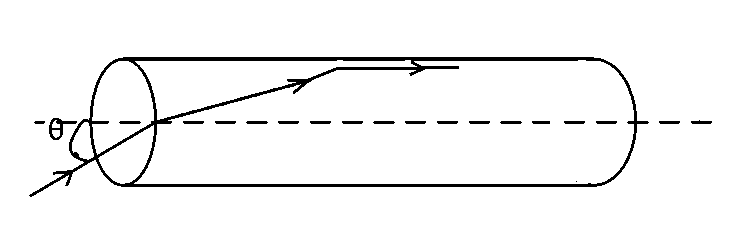
The incident angle $$\theta $$ for which the light ray grazes along the wall of the rod is :
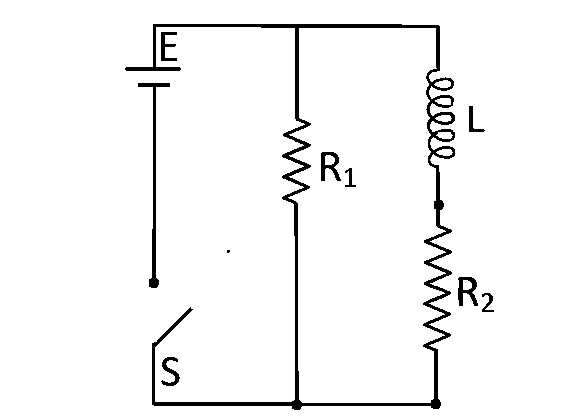
Responder(C)$${\sin ^{ - 1}}\left( {{1 \over {\sqrt 3 }}} \right)$$ - 8An inductor of inductance $$L=400$$ $$mH$$ and resistors of resistance $${R_1} = 2\Omega $$ and $${R_2} = 2\Omega $$ are connected to a battery of $$emf$$ $$12$$ $$V$$ as shown in the figure. The internal resistance of the battery is negligible. The switch $$S$$ is closed at $$t=0.$$ The potential drop across $$L$$ as a function of time is :
 Responder(C)$$12{e^{ - 5t}}V$$
 - 9A mixture of light, consisting of wavelength $$590$$ $$nm$$ and an unknown wavelength, illuminates Young's double slit and gives rise to two overlapping interference patterns on the screen. The central maximum of both lights coincide. Further, it is observed that the third bright fringe of known light coincides with the $$4$$th bright fringe of the unknown light. From this data, the wavelength of the unknown light is :Responder(B)$$442.5$$ $$nm$$
- 10A current loop $$ABCD$$ is held fixed on the plane of the paper as shown in the figure. The arcs $$BC$$ (radius $$= b$$) and $$DA$$ (radius $$=a$$) of the loop are joined by two straight wires $$AB$$ and $$CD$$. A steady current $$I$$ is flowing in the loop. Angle made by $$AB$$ and $$CD$$ at the origin $$O$$ is $${30^ \circ }.$$ Another straight thin wire steady current $${I_1}$$ flowing out of the plane of the paper is kept at the origin.
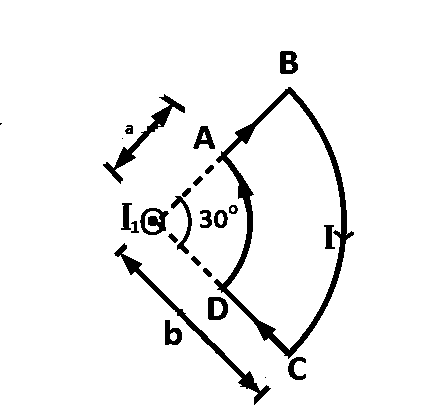
Due to the presence of the current $${I_1}$$ at the origin:
Responder(A)The forces on $$AD$$ are $$BC$$ are zero. - 11A current loop $$ABCD$$ is held fixed on the plane of the paper as shown in the figure. The arcs $$BC$$ (radius $$= b$$) and $$DA$$ (radius $$=a$$) of the loop are joined by two straight wires $$AB$$ and $$CD$$. A steady current $$I$$ is flowing in the loop. Angle made by $$AB$$ and $$CD$$ at the origin $$O$$ is $${30^ \circ }.$$ Another straight thin wire steady current $${I_1}$$ flowing out of the plane of the paper is kept at the origin.
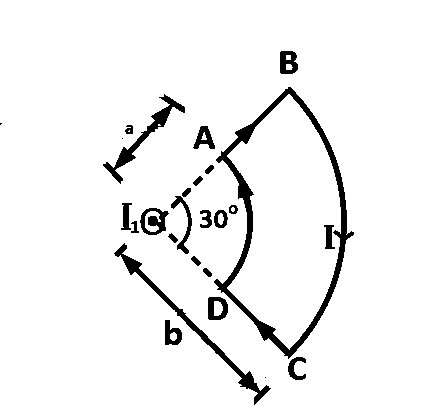
The magnitude of the magnetic field $$(B)$$ due to the loop $$ABCD$$ at the origin $$(O)$$ is :
Responder(A)$${{{\mu _0}I\left( {b - a} \right)} \over {24ab}}$$ - 13Consider a rubber ball freely falling from a height $$h=4.9$$ $$m$$ onto a horizontal elastic plate. Assume that the duration of collision is negligible and the collision with the plate is totally elastic.
Then the velocity as a function of time and the height as a function of time will be :Responder(B)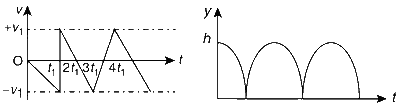
- 14Statement-1 : For a charged particle moving from point $$P$$ to point $$Q$$, the net work done by an electrostatic field on the particle is independent of the path connecting point $$P$$ to point $$Q.$$
Statement-2 : The net work done by a conservative force on an object moving along a closed loop is zero.Responder(A)Statement-1 is true, Statement-2 is true; Statement-2 is the correct explanation of Statement-1. - 16Let $$P\left( r \right) = {Q \over {\pi {R^4}}}r$$ be the change density distribution for a solid sphere of radius $$R$$ and total charge $$Q$$. For a point $$'p'$$ inside the sphere at distance $${r_1}$$ from the center of the sphere, the magnitude of electric field is :Responder(B)$${{Qr_1^2} \over {4\pi \,{ \in _0}\,{R^4}}}$$
- 24Statement - 1: The temperature dependence of resistance is usually given as $$R = {R_0}\left( {1 + \alpha \,\Delta t} \right).$$ The resistance of wire changes from $$100\Omega $$ to $$150\Omega $$ when its temperature is increased from $${27^ \circ }C$$ to $${227^ \circ }C$$. This implies that $$\alpha = 2.5 \times {10^{ - 3}}/C.$$
Statement - 2: $$R = {R_0}\left( {1 + \alpha \,\Delta t} \right)$$ is valid only when the change in the temperature $$\Delta T$$ is small and $$\Delta T = \left( {R - {R_0}} \right) < < {R_0}.$$
Responder(C)Statement - 1 is false, Statement - 2 is true - 25Two wires are made of the same material and have the same volume. However wire $$1$$ has cross-sectional area $$A$$ and wire $$2$$ has cross-sectional area $$3A.$$ If the length of wire $$1$$ increases by $$\Delta x$$ on applying force $$F,$$ how much force is needed to stretch wire $$2$$ by the same amount?Responder(C)$$9F$$
- 29In an experiment the angles are required to be measured using an instrument, 29 divisions of the main scale exactly coincide with the 30 divisions of the vernier scale. If the smallest division of the main scale is half-a degree(=$$0.5^\circ $$), then the least count of the instrument is:Responder(A)one minute