Which of the following is most advanced in the evolutionary trend of animals?
Responder
(D)
Cockroach
2
Which of the following is the lowest category of classification?
Responder
(B)
species
3
Plants that show secondary growth are usually found among the
Responder
(D)
dicotyledons
4
The fungi are distinct group of eukaryote mainly because they have
Responder
(B)
no chlorophyll
5
An arthropod that is destructive at early stage of its life cycle is
Responder
(A)
butterfly
6
An animal body that can be cut along its axis in any plane to give two identical parts is said to be
Responder
(A)
radially symmetrical
7
Which of the following possesses mammary gland?
Responder
(B)
whale
8
The feature that links birds to reptiles in evolution is the possession of
Responder
(D)
scales
9
Countershading is an adaptive feature that enables animals to
Responder
(B)
remain undetected
10
Which of the following plant structures lacks a waterproof cuticle?
Responder
(C)
root
11
In the mammalian male reproductive system, the part that serves as a passage for both urine and semen is the
Responder
(A)
urethra
12
In plants which of the following is required in minute quantities for growth?
Responder
(A)
Copper
13
Which of the following organisms is both parasitic and autotrophic?
Responder
(B)
Loranthus
14
A function of the hydrochloric acid produced in the human stomach during digestion is to
Responder
(C)
stop the action of ptyalin
15
Which of the following is a polysaccharide?
Responder
(D)
Cellulose
16
In the kidney of mammals, the site of ultrafiltration is the
Responder
(B)
Bowman's capsule
17
Which of the following is involved in secondary thickening in plants?
Responder
(D)
Vascular cambium and cork cambium
18
An example of a fruit that develops from a single carpel is
Responder
(C)
bean
19
Plant growth can be artificially stimulated by the addition of
Responder
(A)
gibberellin
20
The autonomic nervous system consists of neurons that control the
Responder
(B)
heart beat
21
The water cycle is maintained mainly by
Responder
(B)
evaporation and condensation of water in the environment
22
Plants of temperate origin can be grown in tropical areas in the vegetation zones of the
Responder
(B)
guinea savanna
23
Organisms living in an estuarine habitat are adapted to
Responder
(C)
withstand wide fluctuations in salinity
24
The presence of stilt roots, pneumatophores, sunken stomata and salt glands are adaptive features of plants found in the
Responder
(B)
mangrove swamps
25
Which of the following animals can exist solely on the water they get from food and metabolic reactions?
Responder
(B)
Desert dwellers
26
The most likely first colonizers of a bare rock are
Responder
(C)
lichen
27
The carrying capacity of a habitat is reached when the population growth begins to
Responder
(D)
remain steady
28
The abiotic factors that control human population include
Responder
(C)
flooding and earthquake
29
An indigenous method of renewing and maintaining soil fertility is by
Responder
(D)
crop rotation and shifting cultivation
30
The diseases caused by water-borne pathogens include
Responder
(D)
typhoid and cholera
31
Which of the following is true in blood transfusion?
Responder
(A)
person of blood group AB can donate blood only to another person of blood group AB
32
A yellow maize is planted and all the fruits obtained are of yellow seeds. When they are croos-bred, yellow seeds and white seeds are obtained in a ratio 3:1 . The yellow seed is said to be
Responder
(D)
a dominant trait
33
When a colour-blind man marries a carrier woman. What is the probability of their offspring being colour blind?
Responder
(B)
50%
34
The correct base pairing for DNA is
Responder
(A)
adenine → thymine and guanine → cytosine
35
The short thick beak in birds is an adaptation for
Responder
(A)
crushing seeds
36
The basking of Agama lizards in the sun is to
Responder
(B)
raise their body temperature to become active
37
The significance of a very large number of termites involved in nuptial swarming is to
Responder
(C)
search for a favourable place to breed
38
The use and disuse of body parts and the inheritance of acquired traits were used to explain
Responder
(B)
Lamarck's theory
39
From his study of Galapagos finches, Darwin derived his theory of evolution from
Responder
(B)
comparative physiology
40
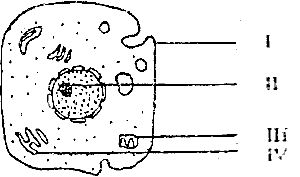
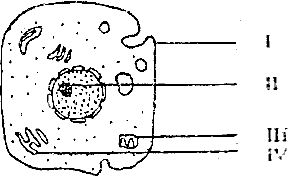
Use the diagram above to answer this question.
The organelle responsible for heredity is labelled
Responder
(B)
ll
41
Use the diagram above to answer this question.
The part labelled IV is the
Responder
(C)
endoplasmic reticulum
42
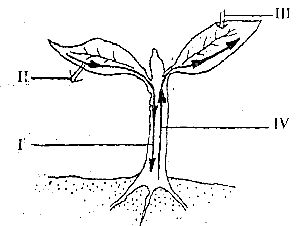
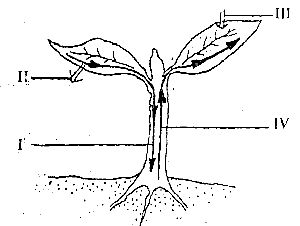
Use the diagram above to answer this question.Arrows represent directional movement materials.
Transportation in the xylem is represented by
Responder
(D)
IV
43
Use the diagram above to answer this question. Arrows represent directional movement materials.
The arrow labelled ll represents the
Responder
(A)
release of oxygen
44
Use the diagram above to answer this question.
The developing embryo is usually contained in the part labelled