WAEC - Biology (1998)
1
Which of the following organisms exhibits both plant and animal characteristics?
2
Which of the following is not an organ?
3
One major difference between osmosis and diffusion is that diffusion
Svare(A)
does not need a semipermeable membrane
4
Which of the following is a difference between mitosis and meiosis?
Svare(C)
Pairing of homologous chromosomes
5
Which of the following can be used for vegetative propagation?
6
Which of the following is a method of artificial vegetative propagation?
7
The above diagram represents a
8
The part labelled II in the diagram is the
9
The part labelled IV in the diagram is the
10
Which of the following is not a function of the blood?
11
Which of the following statements about the circulation of blood is not correct?
Svare(D)
The oxygenated blood enters the lungs through the pulmonary vein
12
A difference between the auricle and the ventricle of the mammalian heart is that the
Svare(E)
Walls of the ventricles are more muscular than that of the auricles
13
Which of the following organism respires through the body surface
14
The stomata of a leaf performs the same function as
15
Which of the following does not happen during inspiration?
16
Which of the these is not an excretory product of plant?
17
Which of these is not a function of the kidney?
18
In which part of the kidney does ultrafiltration take place?
19
Which of the following organs is concerned with detoxication of harmful compounds?
20
The hormone that promotes secondary sexual characteristics in females is
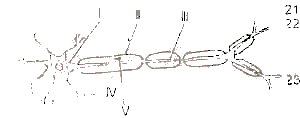
21
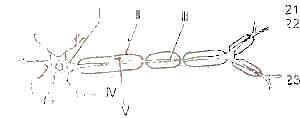
The cell body in the diagram labelled
22
The function of the part labelled II in the diagram is to
23
The organ responsible for equalising air pressure in the ear is
the
24
Which of the following organisms lacks a reproductive organ?
25
Which of the following mammalian features acts as a shock-absorber to the developing embryo?
26
The collective name for the female parts of the flower is
27
If the petals of a flowering plant are removed. Which of the following processes is likely to be affected?
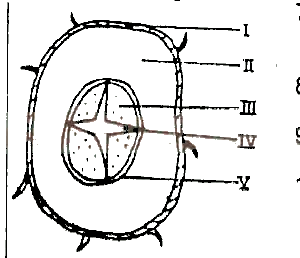
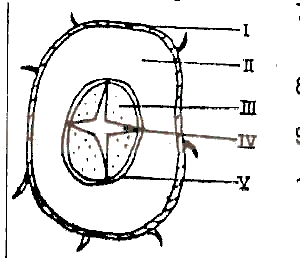
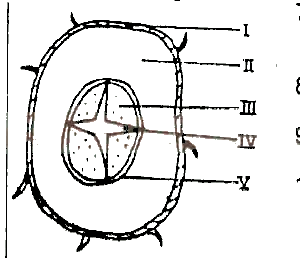
28
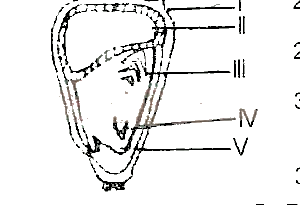
The part labelled II in the diagram is the
29
The part labelled IV in the diagram is the
30
The function of the part labelled V in the diagram is the
Svare(D)
protection of the radicle
31
Which of the following is a feature of wind pollinated flowers?
Svare(E)
Smooth, light and numerous pollen grains
32
In testing for starch in a leaf the function of alcohol is to
Svare(E)
extract the chlorophyll from the leaf
33
Which of the following processes removes CO2 from the atmosphere?
34
The role of bacteria in the nitrogen cycle includes the following except
Svare(D)
converting carbohydrates to carbondioxide
35
The mode of nutrition which describes feeding habit in animals is
36
Which of the following organisms has homodont dentition?
37
The pancreatic duct opens into the
38
The enzyme that acts on milk in the stomach is
39
Which of the following plants is a carnivore?
40
Svare(A)
digesting its food extra cellularly
41
Which of the following contains a reducing sugar?
42
Which of the following instrument can be used to measure relative humidity?
43
In a food chain, each stage in the chain is a
44
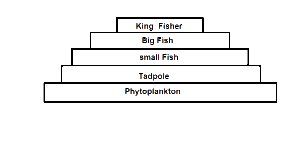
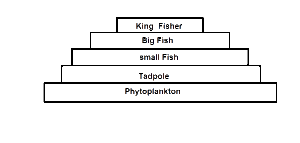
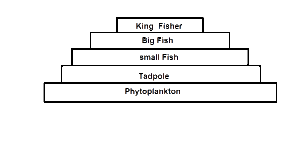
The diagram above illustrates
Svare(C)
the flow of energy in a habitat
45
Which of these organisms occupies the 3rd trophic
level?
46
Which of these organisms is a herbivore?
47
The presence of stilt and breathing roots are features of plants found in the
48
Excessive loss of water from the leaf is prevented by the
49
Which of the following organisms will be a colonizing species of a heap of moist sub soil?
50
The earthworm is important because
51
which of the following plant parts is not a storage organ?
52
Which of the following statements about poliomyelitis is not correct. It
53
Oil is sprayed over stagnant water in which mosquitoes breed in order to
Svare(B)
prevent larva or pupa from attaching itself to the surface
54
In animals the main protective covering is found in the
55
How many chromosomes will be present in a gamete if the somatic cell has eight(8) chromosomes?