JEE MAIN - Physics (2008)
- 3This question contains Statement- 1 and Statement- 2. Of the four choices given after the statements, choose the one that best describes the two statements:
Statement- 1:
Energy is released when heavy nuclei undergo fission or light nuclei undergo fusion andStatement- 2:
For heavy nuclei, binding energy per nucleon increases with increasing $$Z$$ while for light nuclei it decreases with increasing $$Z.$$Jawab(D)Statement - $$1$$ is true, Statement - $$2$$ is false - 5In an experiment, electrons are made to pass through a narrow slit of width $$'d'$$ comparable to their de Broglie wavelength. They are detected on a screen at a distance $$'D'$$ from the slit (see figure).
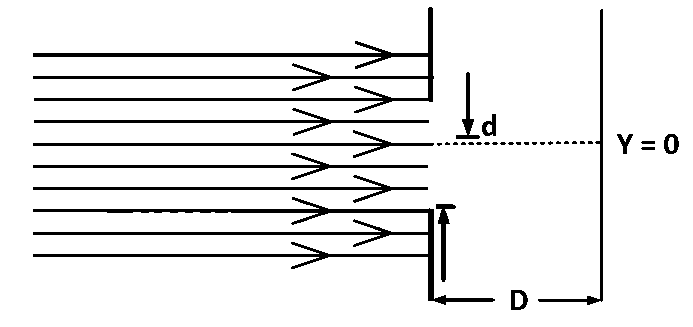
Which of the following graphs can be expected to represent the number of electrons $$'N'$$ detected as a function of the detector position $$'y'\left( {y = 0} \right.$$ corresponds to the middle of the slit$$\left. \, \right)$$
Jawab(D)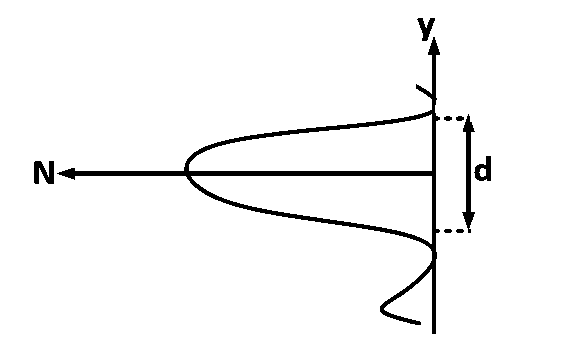
- 7Two coaxial solenoids are made by winding thin insulated wire over a pipe of cross-sectional area $$A=$$ $$10\,\,c{m^2}$$ and length $$=20$$ $$cm$$ . If one of the solenoid has $$300$$ turns and the other $$400$$ turns, their mutual inductance is
$$\left( {{\mu _0} = 4\pi \times {{10}^{ - 7}}\,Tm\,{A^{ - 1}}} \right)$$Jawab(D)$$2.4\pi \times {10^{ - 4}}H$$ - 8A horizontal overhead powerline is at height of $$4m$$ from the ground and carries a current of $$100A$$ from east to west. The magnetic field directly below it on the ground is
$$\left( {{\mu _0} = 4\pi \times {{10}^{ - 7}}\,\,Tm\,\,{A^{ - 1}}} \right)$$Jawab(C)$$5 \times {10^{ - 6}}\,T$$ southward - 11Consider a block of conducting material of resistivity $$'\rho '$$ shown in the figure. Current $$'I'$$ enters at $$'A'$$ and leaves from $$'D'$$. We apply superposition principle to find voltage $$'\Delta V'$$ developed between $$'B'$$ and $$'C'$$. The calculation is done in the following steps:
(i) Take current $$'I'$$ entering from $$'A'$$ and assume it to spread over a hemispherical surface in the block.
(ii) Calculate field $$E(r)$$ at distance $$'r'$$ from A by using Ohm's law $$E = \rho j,$$ where $$j$$ is the current per unit area at $$'r'$$.
(iii) From the $$'r'$$ dependence of $$E(r)$$, obtain the potential $$V(r)$$ at $$r$$.
(iv) Repeat (i), (ii) and (iii) for current $$'I'$$ leaving $$'D'$$ and superpose results for $$'A'$$ and $$'D'.$$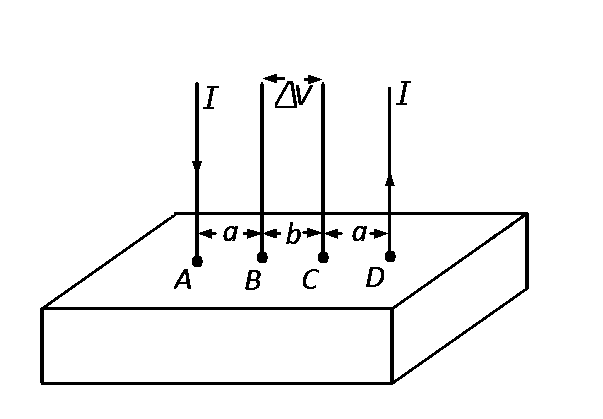
$$\Delta V$$ measured between $$B$$ and $$C$$ is
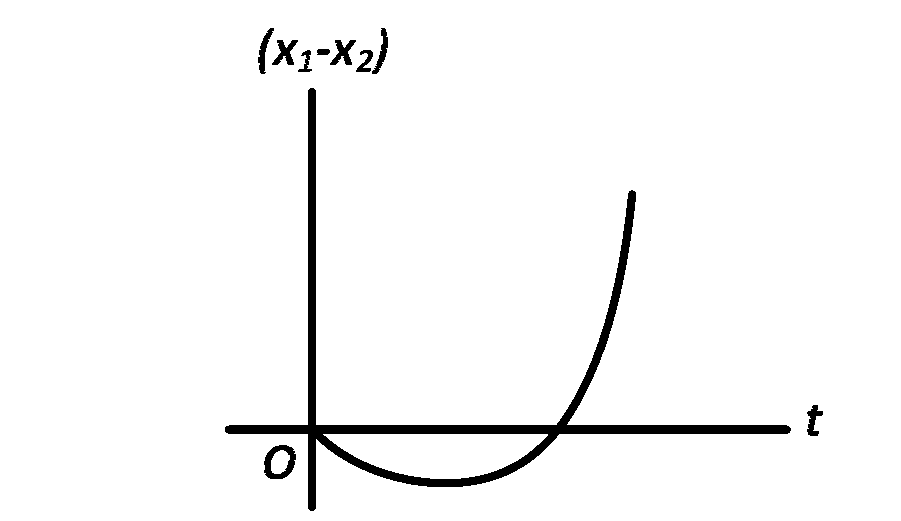
Jawab(A)$${{\rho I} \over {\pi a}} - {{\rho I} \over {\pi \left( {a + b} \right)}}$$ - 12A body is at rest at $$x=0.$$ At $$t=0,$$ it starts moving in the positive $$x$$-direction with a constant acceleration. At the same instant another body passes through $$x=0$$ moving in the positive $$x$$ direction with a constant speed. The position of the first body is given by $${x_1}\left( t \right)$$ after time $$'t';$$ and that of the second body by $${x_2}\left( t \right)$$ after the same time interval. Which of the following graphs correctly describes $$\left( {{x_1} - {x_2}} \right)$$ as a function of time $$'t'$$ ?Jawab(B)
- 13Consider a block of conducting material of resistivity $$'\rho '$$ shown in the figure. Current $$'I'$$ enters at $$'A'$$ and leaves from $$'D'$$. We apply superposition principle to find voltage $$'\Delta V'$$ developed between $$'B'$$ and $$'C'$$. The calculation is done in the following steps:
(i) Take current $$'I'$$ entering from $$'A'$$ and assume it to spread over a hemispherical surface in the block.
(ii) Calculate field $$E(r)$$ at distance $$'r'$$ from A by using Ohm's law $$E = \rho j,$$ where $$j$$ is the current per unit area at $$'r'$$.
(iii) From the $$'r'$$ dependence of $$E(r)$$, obtain the potential $$V(r)$$ at $$r$$.
(iv) Repeat (i), (ii) and (iii) for current $$'I'$$ leaving $$'D'$$ and superpose results for $$'A'$$ and $$'D'.$$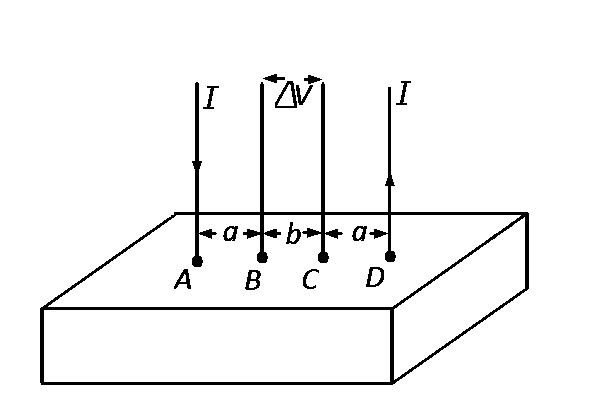
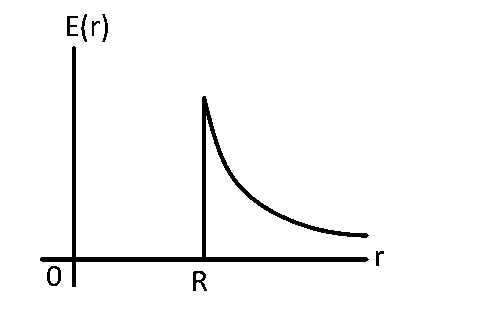
For current entering at $$A,$$ the electric field at a distance $$'r'$$ from $$A$$ is
Jawab(C)$${{\rho I} \over {2\pi {r^2}}}$$ - 14This question contains Statement - $$1$$ and Statement - $$2$$. of the four choices given after the statements, choose the one that best describes the two statements.
Statement - $$1$$:
For a mass $$M$$ kept at the center of a cube of side $$'a'$$, the flux of gravitational field passing through its sides $$4\,\pi \,GM.$$
Statement - 2:
If the direction of a field due to a point source is radial and its dependence on the distance $$'r'$$ from the source is given as $${1 \over {{r^2}}},$$ its flux through a closed surface depends only on the strength of the source enclosed by the surface and not on the size or shape of the surface.Jawab(B)Statement - $$1$$ is true, Statement - $$2$$ is true; Statement - $$2$$ is a correct explanation for Statement - $$1$$ - 17A parallel plate capacitor with air between the plates has capacitance of $$9$$ $$pF.$$ The separation between its plates is $$'d'.$$ The space between the plates has dielectric constant $${k_1}$$ $$=3$$ and thickness $${d \over 3}$$ while the other one has dielectric constant $${k_2} = 6$$ and thickness $${{2d} \over 3}$$. Capacitance of the capacitor is nowJawab(C)$$40.5$$ $$pF$$
- 18A wave travelling along the $$x$$-axis is described by the equation $$y(x, t)=0.005$$ $$\cos \,\left( {\alpha \,x - \beta t} \right).$$ If the wavelength and the time period of the wave are $$0.08$$ $$m$$ and $$2.0s$$, respectively, then $$\alpha $$ and $$\beta $$ in appropriate units areJawab(A)$$\alpha = 25.00\pi ,\,\beta = \pi $$
- 19While measuring the speed of sound by performing a resonance column experiment, a student gets the first resonance condition at a column length of $$18$$ $$cm$$ during winter. Repeating the same experiment during summer, she measures the column length to be $$x$$ $$cm$$ for the second resonance. ThenJawab(B)$$x > 54$$
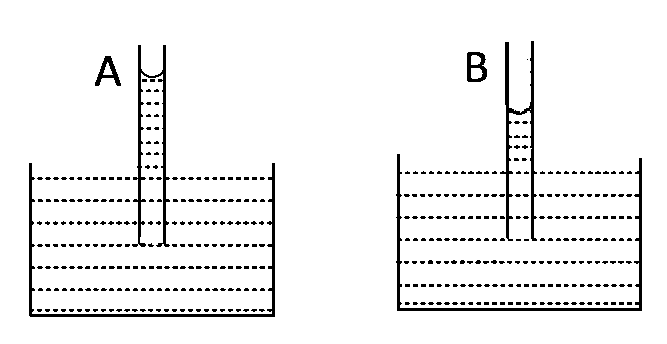
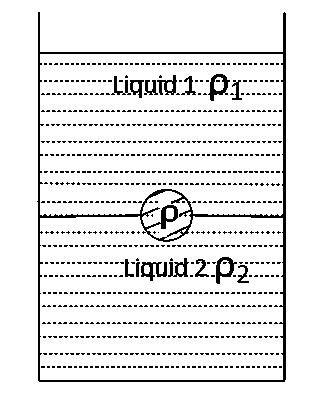
- 20A jar is filled with two non-mixing liquids $$1$$ and $$2$$ having densities $${\rho _1}$$ and $${\rho _2}$$ respectively. A solid ball, made of a material of density $${\rho _3}$$, is dropped in the jar. It comes to equilibrium in the position shown in the figure. Which of the following is true for $${\rho _1}$$ , $${\rho _1}$$ and $${\rho _3}$$ ?
 Jawab(D)$${\rho _1} < {\rho _3} < \rho {}_2$$
 - 22A thin rod of length $$'L'$$ is lying along the $$x$$-axis with its ends at $$x=0$$ and $$x=L$$. Its linear density (mass/length) varies with $$x$$ as $$k{\left( {{x \over L}} \right)^n},$$ where $$n$$ can be zero or any positive number. If the position $${X_{CM}}$$ of the center of mass of the rod is plotted against $$'n',$$ which of the following graphs best approximates the dependence of $${X_{CM}}$$ on $$n$$?Jawab(A)
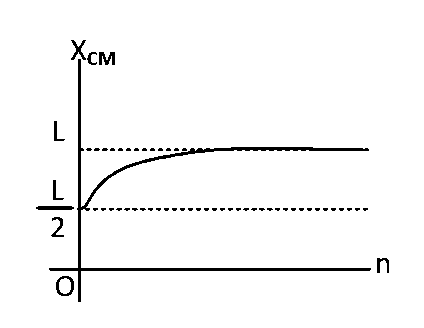
- 23An insulated container of gas has two chambers separated by an insulating partition. One of the chambers has volume $${V_1}$$ and contains ideal gas at pressure $${P_1}$$ and temperature $${T_1}$$. The other chamber has volume $${V_2}$$ and contains ideal gas at pressure $${P_2}$$ and temperature $${T_2}$$. If the partition is removed without doing any work on the gas, the final equilibrium temperature of the gas in the container will beJawab(A)$${{{T_1}{T_2}\left( {{P_1}{V_1} + {P_2}{V_2}} \right)} \over {{P_1}{V_1}{T_2} + {P_2}{V_2}{T_1}}}$$
- 25A spherical solid ball of volume $$V$$ is made of a material of density $${\rho _1}$$. It is falling through a liquid of density $${\rho _2}\left( {{\rho _2} < {\rho _1}} \right)$$. Assume that the liquid applies a viscous force on the ball that is proportional to the square of its speed $$v,$$ i.e., $${F_{viscous}} = - k{v^2}\left( {k > 0} \right).$$ The terminal speed of the ball isJawab(A)$$\sqrt {{{Vg\left( {{\rho _1} - {\rho _2}} \right)} \over k}} $$
- 31Two full turns of the circular scale of a screw gauge cover a distance of 1 mm on its main scale. The total number of divisions on the circular scale is 50. Further, it is found that the screw gauge has a zero error of − 0.03 mm while measuring the diameter of a thin wire, a student notes the main scale reading of 3 mm and the number of circular scale divisions in line with the main scale as 35. The diameter of the wire isJawab(D)3.38 mm