Use the following Classes of Arthropoda to answer the question below
I. Crustacea II. Insecta III. Arachinda IV. Chilopoda
Which members of the classes live mainly in an aquatic habitat?
Atbilde
(A)
I
3
Use the following Classes of Arthropoda to answer the question below
I. Crustacea II. Insecta III. Arachinda IV. Chilopoda
Which of the classes is characterised by the possession of two pairs of antennae?
Atbilde
(A)
I
4
The organism with spiral chloroplasts and nucleus suspended by cytoplasmic strands is
Atbilde
(B)
Spirogyra
5
The network of double membrane that conveys materials through the cytoplasm is the
Atbilde
(D)
endoplasmic reticulum
6
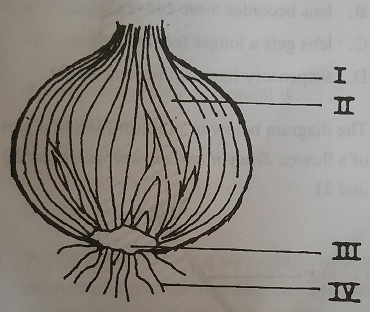
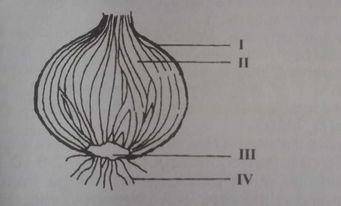
The diagram above is an illustration of the longitudinal section of a plant organ. Study to answer the question below.
Food is stored in the part labeled
Atbilde
(B)
II
7
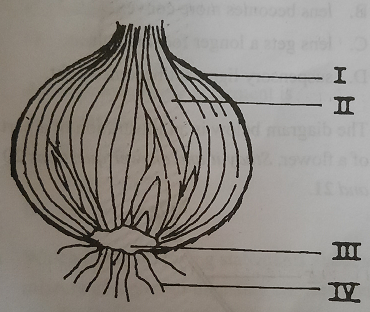
The diagram above is an illustration of the longitudinal section of a plant organ. Study it and answer the question below;
The plant is a?
Atbilde
(B)
bulb
8
The diagram below is an illustration of the longitudinal section of a plant organ. Study it and answer the question below;
The part labeled i is the
Atbilde
(B)
scale leaf
9
Which of the following materials is not a living semi-permeable membrane?
Atbilde
(D)
Sheet of cellophane
10
In an experiment, mould and yeast cells were transferred into an environment with low oxygen concentration. After a few days, the mould dies while the yeast cells did not. Which of the following statements best explains the following observation.
Atbilde
(C)
Respiration can take place in yeast cells in the absence of oxygen
11
Which of the following tissues does not provide support in flowering plants?
Atbilde
(D)
Phloem
12
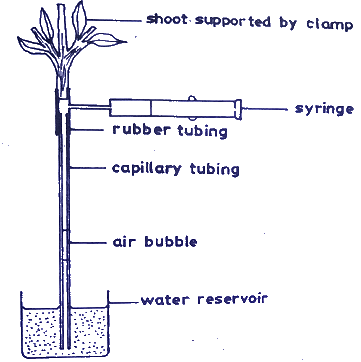
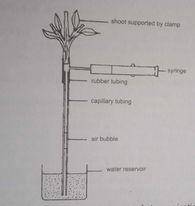
The diagram is an illustration of an experimental set-up. Study it and answer the question;
The set-up directly measure
Atbilde
(A)
transpiration of water by the shoot
13
The diagram above is an illustration of an experimental setup. Study it and answer the question below;
The setup can measure comparatively the rate of
Atbilde
(C)
transpiration of a single shoot of a plant under different experimental conditions
14
The respiratory organ of a cockroach
Atbilde
(B)
trachea
15
The excretory product of some reptiles, birds and insects is
Atbilde
(D)
uric acid
16
The part of the mammalian kidney that stores urine is the
Atbilde
(D)
bladder
17
The properties of endocrine system include the following except
Atbilde
(D)
release of secretion into ducts
18
The part of the central nervous system that controls unconscious actions in humans is the
Atbilde
(C)
spinal cord
19
What happens when the ciliary muscles of the eye contract? The
Atbilde
(B)
lens become more convex
20
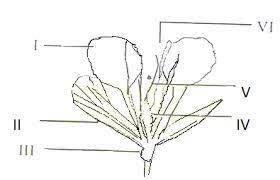
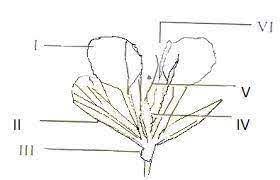
The diagram is an illustration of a part of a flower. Study it and answer the question below;
The function of the part labeled I is
Atbilde
(B)
attract pollinators
21
The diagram below is an illustration of a part of a flower. Study it and answer the question below.
The part labeled II is the
Atbilde
(C)
fused ovaries
22
The reagent used in testing for carbon (IV) oxide is
Atbilde
(B)
lime water
23
Oxygen comes out of the stomata during photosynthesis through the process known as
Atbilde
(A)
diffusion
24
The first stable product of photosynthesis is
Atbilde
(C)
glucose
25
An example of a trace elements is
Atbilde
(D)
copper
26
Which of the following statements about a mixture of a protein-digesting enzyme and starch solution would be correct? The protein-digesting enzyme
Atbilde
(A)
has no effect on the starch solution
27
The mutualism type of relationship is different from a parasitic relationship because in mutualism
Atbilde
(A)
both organisms involved benefit
28
The table below shows the number of some organisms in habitats W and Y. Study it to answer the question below;
Organism
Number in the habitat
habitat W
habitat Y
Plankton
126
0
Antelope
0
51
Water flea
10
0
Tilapia
23
0
Lion
0
6
Frog
6
0
Grass
0
250
What type of habitat is W?
Atbilde
(B)
Pond
29
The table below shows the number of some organisms in habitats W and Y. Study it to answer the question below;
Organism
Number in the habitat
habitat W
habitat Y
Plankton
126
0
Antelope
0
51
Water flea
10
0
Tilapia
23
0
Lion
0
6
Frog
6
0
Grass
0
250
Which of the following statements about habitat W is correct? The
Atbilde
(C)
type of organisms present indicate that habitat is aquatic
30
The table below shows the number of some organisms in habitats W and Y. Study it to answer the question below;
Organism
Number in the habitat
habitat W
habitat Y
Plankton
126
0
Antelope
0
51
Water flea
10
0
Tilapia
23
0
Lion
0
6
Frog
6
0
Grass
0
250
The number of lions and antelops in habitat Y shows that the lion
Atbilde
(B)
is the predator while the antelope is the prey
31
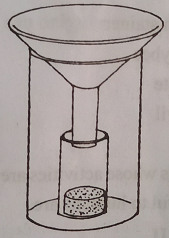
The diagram above illustrates an ecological instrument. Study it and answer the question below;
A disadvantage of the abiotic factor measured by the instrument is that it
Atbilde
(C)
leads to flooding when in excess
32
The diagram below is an illustration of an ecological instrument. Study it an answer the question below;
When the instrument is in use, it is usually?
Atbilde
(A)
placed slightly above soil level
33
Soil with the finest texture is?
Atbilde
(B)
clay
34
The position occupied by an organism in food chain is the
Atbilde
(C)
trophic level
35
The depletion of the ozone layer will result in the earth surface receiving more
Atbilde
(C)
ultraviolet rays
36
Use the list of insects below to answer the question below;
I. Cotton stainer II. Honeybee III. Termite IV. Weevil
The insects whose activities are both beneficial and harmful to humans are;
Atbilde
(B)
II and III
37
Use the list of insects below to answer the question below;
I. Cotton stainer II. Honeybee III. Termite IV. Weevil
Which of the insects destroys grains?
Atbilde
(D)
IV
38
Conservation of natural resources does not
Atbilde
(D)
threaten the survival of species
39
A company was prohibited from producing bags made from natural leopard skin. This is an attempt to conserve
Atbilde
(C)
wildlife
40
Which of the following substances is not a conservable natural resource?
Atbilde
(A)
Mineral
41
A child that can receive blood donation from anybody belongs to the blood group
Atbilde
(D)
AB
42
Variation which exhibits a wide range from one extreme to the other is
Atbilde
(C)
continuous variation
43
Measurements of height and weight of students in a class show
Atbilde
(B)
continuous variation
44
Which of the following statements about chromosomes is correct?