The complete Glorious was Qur’ān taken from Lawn al-mahfuz to the lowest of the heavens known as
Válasz
(A)
Bait al- Izzah “The revelation of the glorious Qur`an passed through three stages, 2 from Lawh al-Mahfuriz to the lowest of the heaven known as “Bait-al-Izzah”
2
The most important ways of preserving the Glorious Qur’ān by Sahǻbah include
Válasz
(A)
establishing schools in major cities and teaching the Glorious Qur’ān
3
What are the characteristics common to most Makkan Suwar?
Válasz
(A)
They are short and poetic
4
The Glorious Qur’ān is a guidance for
Válasz
(A)
The pious “… a guidance to those who are pious”.
5
What will happen on the Day of Judgment according to Q.101:4?
Válasz
(E)
Non of the above “Because the meaning of Q. 101 verse 4 is not in the option A-D. It is Q. 101:5 that translates Option B which is the answer to question 5”.
6
Every human being, according to Sūrah al- Asr is in a state of loss, except the
Válasz
(C)
faithful and righteous “Suratul-Abr” Q:103:3.
7
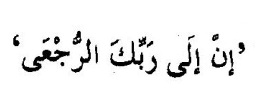
The translation of the verse above is
Válasz
(B)
‘verily, to thy Lord is the return (of all
8
The verse that can be recited for
protection against evil machinations is
Válasz
(D)
Q. 2:255 “Ayatul – Kursiy – Q. 2:255.
9
The official compilation of Hadith was facilitated by
Válasz
(D)
Caliph Umar b. Abdul-Aziz “Umar bin Abdul-Azeez was the one who facilitated the compilation of the Hadith. He was a Umayyad caliph who gave an order to the scholars to collect and compile the traditions”
10
The science of Asma al-rijal is introduced in order to
Válasz
(A)
Authenticate the chains of Hadith narrators
11
The real name of Imam al-Bukhari is
Válasz
(D)
Muhammad b. Isma’il “Imam bukahri’s full name is Muhammad b. Ismail bin Ibrahim al-Bukhari”
12
A Hadith in which the chain of narration and text are sound is known as
Válasz
(D)
Sahih
13
Which of the following directly applies to Hadith ad-Da’if?
Válasz
(A)
It can be used on certain conditions
14
The Glorious Qur’ǻn takes precedence over the Hadith in that
Válasz
(C)
the latter can be invoked against evil “Qur`an is recited during Salat Hadith is not to be used during Salat”.
15
Hadith is important to Muslims because it is
Válasz
(D)
the means through which the prophet’s message is known
16
Which of the following is the correct order of authenticity of three of the six sound collections of the Hadith
Válasz
(A)
Bukhari, Muslim and Tirmidhi
17
The first major written work of a hadith was
Válasz
(C)
Muwata Malik “The Muwatta of Imam Malik bin Annab (died 179AH) is the first of its kind ..
18
The collection of Imam Muslim differs from that of Imam Bukhari in terms of
Válasz
(D)
Characterization
19
Hadith 11 of an-Nawawi admonishes Muslims to
Válasz
(B)
avoid doubtful things “…Leave that about which you are in doubt for that about which you are in no doubt”
20
According to Hadith 41 of an- Nawawi, the faith of a believer is incomplete until he
Válasz
(D)
Follows what has been revealed unto the prophet(SAW)
21
The message in Hadith 34 of an- Nawawi is about
Válasz
(B)
Preventing evil in the society by any means possible “…. Any one amongst you who sees abomination act should change it …..”
22
The Hadith above warns Muslims against charity with
Válasz
(B)
ill-gotten wealth “…Allah the Mighty is good and accepts only that which is good…”
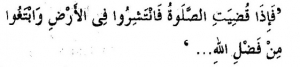
23
The verse above teaches that Muslims should
Válasz
(D)
Disperse into the land and earn a living “…. You may disperse through the land and seek for the bounty of Allah (by working) etc …. Q. 62:10.
24
Good behavior and modesty in dress in Islam is an essential parts of
Válasz
(A)
Amal
25
Hadith 18 of an-Nwawai enjoins believers to
Válasz
(C)
Have piety and work righteously
26
The verse above urges
Válasz
(D)
The believers to be patient and persevere “O you who believe, Endure and be more patient…” Q. 3:103.
27
Q. 3:103 enjoins Muslims to
Válasz
(A)
Unite and not be divided
28
Prophet Muhammad (SAW) was described as the seal of all prophets, meaning that he
Válasz
(A)
Was the last or the prophets of Allah
29
The act of taking refuge from the Jinns as mentioned in Q. 72:6 is that
Válasz
(C)
They would increase such people in fury “And verily there were men going mankind who took shelter with the males among the Jin but the (the Jin) increase them (the mankind) in sin and transgression”. Q. 72:6.
30
The attributes of Allah as contained in Q.59:23 are
Válasz
(D)
8 “The attributes of Allah as contained in Q59: 23 are 8. i.e. 1. The king 2. The Holy 3. The one free from all defects 4. The Giver of security 5. The watcher over his creator 6. The Al-Mighty 7. The compeller 8. The supreme
31
The important of Salah as listed in Q. 29:45 includes
Válasz
(A)
Prohibition of shameful and deeds “…Verily, As Salat prevent from al- Fahshai (i.e. great sins…) and Almunkar … (every kind of evil wicked deed). Q. 29:45
32
Which of the following vitiates Salah?
Válasz
(A)
Intoxication
33
A major activity in Salah performed through various bodily postures is known as
Válasz
(A)
Raka’at “The various bodily postures performed in Salah as a major activity is called Rakat”.
34
In congregational Salah, a person who comes late is expected to
Válasz
(D)
make takbiratul ihram and join the Imam
35
Hajj is one of the avenues for Islamic brotherhood and
Válasz
(D)
unity
36
The type of Zakah due at the end of Ramadan fast is known as
Válasz
(B)
Zakah al-fitr
37
The gathering of pilgrims on the 9th day of Dhul Hijjah is known as
Válasz
(A)
Wuquf bi ‘Arefah
38
The categories of women prohibited in marriage due to blood relations are
Válasz
(C)
10
39
According to Q.4:34, the main right of the
husband over his wife is to
Válasz
(C)
Accept his leadership and obey him
40
A marriage is not valid in Islam without
Válasz
(A)
At least two witnesses “For validity of marriage, there must be at least two witnesses”
41
The right of a husband over his wife excludes
Válasz
(D)
Total controlling the wife’s property
42
Talaq al bai’in technically conveys the idea of
Válasz
(C)
An irrevocable divorce
43
Zihar occurs when a husband compares his
Válasz
(D)
Wife with the back of his mother “Zihar is husband’s comparison of his wife’s back with his mother”.
44
Excluded from inheritance is a
Válasz
(C)
Person who kills his father for his estate “In a case of homicide, the person guilty of murder is barred from inheritance of the person he murdered”
45
Qiy ā s in Islamic law refers to
Válasz
(B)
Analogical deduction “Qiy a s means: Analogical deduction of Law