A demand which gives rise to the reverse of the law of demand is__________
תְשׁוּבָה
(C)
Abnormal demand
2
If two commodities are unrelated, a change in the price of one will____________
תְשׁוּבָה
(B)
have no effect on the quantity demanded of the other
3
Price
(₦)
Quantity Demanded
8
10
6
12
If we move from 8 to 6, the elasticity of demand is_______
תְשׁוּבָה
(C)
0.8
4
In a perfect competition, the market price is determined by_______
תְשׁוּבָה
(D)
the market supply and demand junctions
5
In the short-run, the monopoly makes_______
תְשׁוּבָה
(B)
Abnormal Profit
6
The demand curve facing the monopolist in the foreign market is__________
תְשׁוּבָה
(C)
Perfectly elastic
7
Supply is________
תְשׁוּבָה
(B)
A Flow
8
A rise in the supply of a commodity cause__________
תְשׁוּבָה
(C)
a decrease in the equilibrium price and an increase in the equilibrium quantity bought and sold
9
The method obtained by adding all the reward of factors of production in national income is________
תְשׁוּבָה
(A)
income approach
10
An economy in which the whole income is not consumed is referred to as______
תְשׁוּבָה
(A)
Frugal economy
11
The arithmetic mean of 5, 8, 10, 15, 24 and 28 is_______
תְשׁוּבָה
(B)
15
12
A method of analysis that draws conclusions from data rather than general Principles already known is________
תְשׁוּבָה
(A)
Deductive reasoning
13
The money market equilibrium is defined as_________
תְשׁוּבָה
(A)
when the demand and supply of money are equal
14
An economic condition in which much reduced economic activity co-exists with inflation is referred to as__________
תְשׁוּבָה
(C)
slump inflation
15
An Instrument used by the central bank to fix commercial and merchant banks total credit to domestic economy is________
תְשׁוּבָה
(C)
credit ceiling
16
Restrictive monetary policy is designed to curtail aggregate demand and to overcome________
תְשׁוּבָה
(D)
Inflationary gap
17
The average curve and the marginal curve are U-shaped in the short-run and flatter in the long-run due to________
תְשׁוּבָה
(A)
Economies of scale
18
The most important cost curve for the firm is_________
תְשׁוּבָה
(B)
AC
19
In the case of highly or close complementary goods, the indifference curve is_______
תְשׁוּבָה
(D)
Curvature
20
One of these is not an assumption of the cardinalist theory of utility?
תְשׁוּבָה
(D)
Consistency and transivity of choice
21
The shape of the production possibility frontier is determined by the_________
תְשׁוּבָה
(B)
law of diminishing returns
22
As indifference curve shows equal level of satisfaction at all points, An isoquant shows equal level of_________
תְשׁוּבָה
(C)
Output
23
Which of the following is not a cause of unemployment_______
תְשׁוּבָה
(C)
good government planning
24
The demand for labour is a________
תְשׁוּבָה
(A)
Derived demand
25
The use of government income and expenditure instrument to regulate the economy is termed______
תְשׁוּבָה
(C)
fiscal policy
26
A form of tax that is mildly progressive and regressive is_______
תְשׁוּבָה
(A)
Proportional tax
27
Industrialization is the process of___________
תְשׁוּבָה
(B)
transforming as economy based on extractive to manufacturing
28
One of these is not a way by which government encourage industrialization?
תְשׁוּבָה
(C)
Low Productivity and inefficiency
29
The sector which contribute highly to the economy is___________
תְשׁוּבָה
(A)
Primary sector
30
A permit that allows an importer to bring a certain quantity of foreign goods into a country is_________
תְשׁוּבָה
(C)
Import quota
31
The lands that belong to the community is referred to as__________
תְשׁוּבָה
(C)
communal land
32
Among the disadvantages of the one-man business is the fact that______
תְשׁוּבָה
(B)
the proprietor is personally liable for the firm's debts
33
The most reliable and acceptable index of economic growth is the__________
תְשׁוּבָה
(C)
National Income
34
The release of a liquid petroleum hydrocarbon into the environment is_______
תְשׁוּבָה
(B)
Oil spill
35
ECOWAS was formed for the purpose of________
תְשׁוּבָה
(A)
promoting co-operation and integration
36
Economics is a social science concerned with the proper use and______
תְשׁוּבָה
(C)
allocation of resources for growth
37
The determination of price by bargaining between buyers and sellers is________
תְשׁוּבָה
(C)
Higgling and Haggling
38
An economy system that uses what is regarded as the "Market mechanism" is called_______
תְשׁוּבָה
(D)
Capitalism
39
The last link in the channel of distribution is____________
תְשׁוּבָה
(C)
Consumer
40
John an apprentice, engineer and amateur trumpet player, was earning ₦30 per week before accepting Full-time employment in a top orchestra, for which he now receives ₦150 per week. ₦120 of his current weekly earnings can be described as________
תְשׁוּבָה
(D)
economic rent
41
Effective demand for a commodity is desire for that commodity backed by_______
תְשׁוּבָה
(B)
ability and willingness to pay
42
A commodity is defined as normal when its demand changes in the same direction as______
תְשׁוּבָה
(A)
income
43
Which of the following matters may account for changes in demand?
I - changes in consumer preferences
II - changes in real income
III - changes in distribution of incomes
IV - changes in levels of taxation
תְשׁוּבָה
(D)
I, II, III, IV
44
An example of a market which approaches fairly near to perfection is____________
תְשׁוּבָה
(D)
the foreign exchange market
45
Whether a monopolist is able to increase his revenue by restricting his output depends on the shape of the_________
תְשׁוּבָה
(C)
demand curve
46
An example of a vertical combination is the merger of_________
תְשׁוּבָה
(A)
a spinning firm and a wearing firm
47
When of the following matters may account for changes in supply?
I - technological advances in an industry
II - changes in labour costs
III - changes in source of supply
IV - changes in levels of taxation
תְשׁוּבָה
(D)
I, II, III, IV
48
A supply curve slopes upwards from the left to the right indicating__________
תְשׁוּבָה
(B)
a positive slope
49
Use the following information given to answer this question
Total of all expenditure incurred during the year ₤ 80,000m
Indirect taxes on goods and services ₤ 8,000m
Capital consumption ₤ 6,000m
National income is__________
תְשׁוּבָה
(B)
₤ 66,000m
50
Use the following information given to answer this question
Total of all expenditure incurred during the year ₤80,000 m
Indirect taxes on goods and services ₤8,000m
Capital consumption ₤6,000m
Gross national expenditure at factor cost is_________
תְשׁוּבָה
(C)
₤ 74,000μ
51
Let the quantity demanded in units of a particular commodity be represented as Qd = 80 - 2P, find the quantity demanded when P = ₦3.
תְשׁוּבָה
(C)
74
52
The following are measures of location except________
תְשׁוּבָה
(C)
Range
53
The term M \(^3\) comprises M \(^1\) together with deposits on deposit account held by_______
תְשׁוּבָה
(C)
banks and discount houses
54
The second equation of exchange is__________
תְשׁוּבָה
(B)
P = \(\frac {M}{KR}\)
55
The term "Money at call and short notice" in a bank's assets represents the bank's loans to______
תְשׁוּבָה
(D)
the money markets
56
A contractionary monetary policy is used to control__________
תְשׁוּבָה
(B)
Inflation
57
Consider the following figures which refer to a firm's production department during one week:
Wage bill ₦6,000, Rent, Rates, Depreciation ₦200, raw materials ₦800, Power ₦300.
Total variable costs incurred during the week are
תְשׁוּבָה
(B)
₦7,100
58
If AC and MC are represented on a graph, the MC curve will cut the AC curve_______
תְשׁוּבָה
(C)
at the minimum point on the AC curve
59
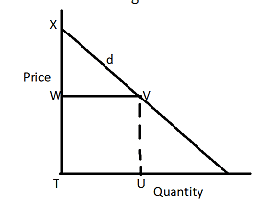
Consider the diagram below which shows a demand curve (d).
Total expenditure on a commodity is represented by the area TUVW. Consumer's surplus is represented by___________
תְשׁוּבָה
(A)
The area VWX
60
Adam Smith's Theory of value stated that the value of a commodity depended on________
תְשׁוּבָה
(C)
The amount of labour expended on its production
61
Which of the following persons is engaged in "Secondary Production"?
I - a bricklayer
II - an automobile assembly-line worker
III - an accountant
IV - a cinema projectionist
תְשׁוּבָה
(B)
I, II
62
Let capital formation = CF, Production = P, C = consumption. Then CF =_______
תְשׁוּבָה
(A)
P - C
63
If wage rate is less than the average revenue product, the firms would be earning________
תְשׁוּבָה
(B)
super normal profit
64
The determination of wages in a labour market depends on the_______
תְשׁוּבָה
(C)
Interaction between demand and supply of labour
65
If the demand for a commodity is perfectly elastic, the incidence of a tax on that commodity will be, other things being equal, entirely on the_______
תְשׁוּבָה
(B)
seller
66
Most of the National debts is "dead weight" in the sense that is____
תְשׁוּבָה
(D)
not covered by any real asset
67
The basic principle underlying location of industry is the tendency for production of a commodity to be located on the basis of______
The birth rate in 1976 for a certain country with a population of 10m was 8.0. This means that in 1976,___________
תְשׁוּבָה
(A)
there were 80,000 live births in the country
70
Assume that, for a certain country in a given year, the index of import prices stands at 102, the index of export prices stands at 106. The terms of trade are (to the nearest whole number)
תְשׁוּבָה
(B)
104
71
One of these is not a problem of agriculture___________
תְשׁוּבָה
(A)
provision of employment
72
The business risks of a public corporation are borne ultimately________
תְשׁוּבָה
(D)
by the tax payers
73
Poverty simply refers to the low level of________
תְשׁוּבָה
(B)
per capita income
74
The oil boom between 1970 - 1980 caused the oil sector to become____________
תְשׁוּבָה
(A)
the main source of government
75
When a member's currency is declared "scarce", it is the duty of the IMF to______