JEE Advance - Mathematics (1981)

  • 1
    Show that : $$\mathop {\lim }\limits_{n \to \infty } \left( {{1 \over {n + 1}} + {1 \over {n + 2}} + .... + {1 \over {6n}}} \right) = \log 6$$
    پاسخ دهید
    (A)
    The limit can be evaluated by recognizing it as a Riemann sum approximation of the integral of 1/x from 1 to 6.
  • 2
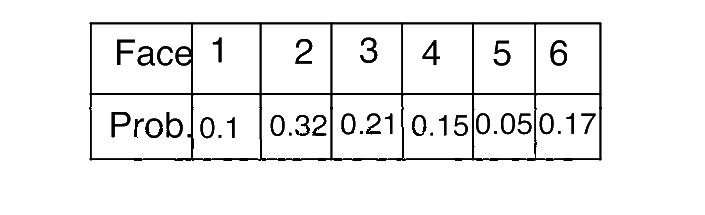
    For a biased die the probabilities for the different faces to turn up are given below : IIT-JEE 1981 Mathematics - Probability Question 129 English

    This die tossed and you are told that either face $$1$$ or face $$2$$ has turned up. Then the probability that it is face $$1$$ is ...............

    پاسخ دهید
    (A)
    5/21
  • 3
    An anti-aircraft gun can take a maximum of four shots at an enemy plane moving away from it. The probabilities of hitting the plane at the first, second, third and fourth shot are $$0.4, 0.3, 0.2$$ and $$0.1$$ respectively. What is the probability that the gun hits the plane?
    پاسخ دهید
    (C)
    0.69
  • 4
    Let $$\overrightarrow A ,\overrightarrow B ,\overrightarrow C $$ be vectors of length $$3, 4, 5$$ respectively. Let $$\overrightarrow A $$ be perpendicular to $$\overrightarrow B + \overrightarrow C ,\overrightarrow B $$ to $$\overrightarrow C + \overrightarrow A $$ to $$\overrightarrow A + \overrightarrow B .$$ Then the length of vector $$\overrightarrow A + \overrightarrow B + \overrightarrow C $$ is ..........
    پاسخ دهید
    (B)
    5√2
  • 5
    Let $$\overrightarrow A ,\overrightarrow B $$ and $${\overrightarrow C }$$ be unit vectors suppose that $$\overrightarrow A .\overrightarrow B = \overrightarrow A .\overrightarrow C = 0,$$ and thatthe angle between $${\overrightarrow B }$$ and $${\overrightarrow C }$$ is $$\pi /6.$$ Then $$\overrightarrow A = \pm 2\left( {\overrightarrow B \times \overrightarrow C } \right).$$
    پاسخ دهید
    (B)
    FALSE
  • 6
    The scalar $$\overrightarrow A .\left( {\overrightarrow B + \overrightarrow C } \right) \times \left( {\overrightarrow A + \overrightarrow B + \overrightarrow C } \right)$$ equals :
    پاسخ دهید
    (A)
    $$0$$
  • 7
    Find the area bounded by the curve $${x^2} = 4y$$ and the straight
    پاسخ دهید
    (C)
    9/8 sq. units
  • 8
    Suppose that the normals drawn at three different points on the parabola $${y^2} = 4x$$ pass through the point $$(h, k)$$. Show that $$h>2$$.
    پاسخ دهید
    (D)
    The statement is false for h < 2.
  • 9
    The general solution of the trigonometric equation sin x+cos x=1 is given by:
    پاسخ دهید
    (C)
    $$x = n\pi + {\left( { - 1} \right)^n}\,\,\,\,\,\,\,{\pi \over 4} - {\pi \over 4}$$ ; $$n = 0,\, \pm 1,\, \pm 2..$$
  • 10
    For complex number $${z_1} = {x_1} + i{y_1}$$ and $${z_2} = {x_2} + i{y_2},$$ we write $${z_1} \cap {z_2},\,\,if\,\,{x_1} \le {x_2}\,\,and\,\,{y_1} \le {y_2}.$$
    Then for all complex numbers $$z\,\,with\,\,1 \cap z,$$ we have $${{1 - z} \over {1 + z}} \cap 0.$$
    پاسخ دهید
    (B)
    FALSE
  • 11
    The complex numbers $$z = x + iy$$ which satisfy the equation $$\,\left| {{{z - 5i} \over {z + 5i}}} \right| = 1$$ lie on
    پاسخ دهید
    (A)
    the x-axis
  • 12
    Let the complex number $${{z_1}}$$, $${{z_2}}$$ and $${{z_3}}$$ be the vertices of an equilateral triangle. Let $${{z_0}}$$ be the circumcentre of the triangle. Then prove that $$z_1^2 + z_2^2 + z_3^2 = 3z_0^2$$.
    پاسخ دهید
    (A)
    The given equation holds true if and only if the triangle is equilateral and $$z_0$$ is its circumcenter.
  • 13
    For every integer n > 1, the inequality $${(n!)^{1/n}} < {{n + 1} \over 2}$$ holds.
    پاسخ دهید
    (B)
    FALSE
  • 14
    Five balls of different colours are to be placed in there boxes of different size. Each box can hold all five. In how many different ways can be place the balls so that no box remains emply?
    پاسخ دهید
    (B)
    300
  • 15
    The area enclosed within the curve $$\left| x \right| + \left| y \right| = 1$$ is .................
    پاسخ دهید
    (B)
    2 sq. units
  • 16
    Let A be the centre of the circle $${x^2}\, + \,{y^2}\, - \,2x\,\, - 4y\, - 20 = 0\,$$. Suppose that the tangents at the points B (1, 7) and D (4. - 2) on the circle meet at the point C. Find the area of the quadrilateral ABCD.
    پاسخ دهید
    (B)
    72 sq units
  • 17
    Find the equations of the circle passing through (- 4, 3) and touching the lines x + y = 2 and x - y = 2.
    پاسخ دهید
    A
    B
  • 18
    The equation $${{{x^2}} \over {1 - r}} - {{{y^2}} \over {1 + r}} = 1,\,\,\,\,r > 1$$ represents
    پاسخ دهید
    (D)
    none of these
  • 19
    Each of the four inequalties given below defines a region in the $$xy$$ plane. One of these four regions does not have the following property. For any two points $$\left( {{x_1},{y_1}} \right)$$ and $$\left( {{x_2},{y_2}} \right)$$ in the region, the point $$\left( {{{{x_1} + {x_2}} \over 2},{{{y_1} + {y_2}} \over 2}} \right)$$ is also in the region. The inequality defining this region is
    پاسخ دهید
    (C)
    $${x^2} - {y^2} \le 1$$
  • 20
    Suppose $${\sin ^3}\,x\sin 3x = \sum\limits_{m = 0}^n {{C_m}\cos \,mx} $$ is an identity in x, where C0, C1 ,....Cn are constants, and $${C_n} \ne 0$$ , then the value of n is _____.
    پاسخ دهید
    (C)
    6
  • 21
    Let $$y = {e^{x\,\sin \,{x^3}}} + {\left( {\tan x} \right)^x}$$. Find $${{dy} \over {dx}}$$
    پاسخ دهید
    (C)
    ${e^{x\,\sin {x^3}}}\left[ {\sin {x^3} + 3{x^3}\cos {x^3}} \right] + {\left( {\tan x} \right)^x}\left[ {{{x\sec^2 x} \over {\tan x}} + \log \,\tan x} \right]$
  • 22
    Let the angles $$A, B, C$$ of a triangle $$ABC$$ be in A.P. and let $$b:c = \sqrt 3 :\sqrt 2 $$. Find the angle $$A$$.
    پاسخ دهید
    (D)
    75°
  • 23
    Let $$a, b, c$$ be positive real numbers Let
    $$\theta = {\tan ^{ - 1}}\sqrt {{{a\left( {a + b + c} \right)} \over {bc}}} + {\tan ^{ - 1}}\sqrt {{{b\left( {a + b + c} \right)} \over {ca}}} $$ $$ + {\,\,\tan ^{ - 1}}\sqrt {{{c\left( {a + b + c} \right)} \over {ab}}} $$

    Then $$\tan \theta = $$ ____________

    پاسخ دهید
    (A)
    0
  • 24
    Find the value of : $$\cos \left( {2{{\cos }^{ - 1}}x + {{\sin }^{ - 1}}x} \right)$$ at $$x = {1 \over 5}$$, where
    $$0 \le {\cos ^{ - 1}}x \le \pi $$ and $$ - \pi /2 \le {\sin ^{ - 1}}x \le \pi /2$$.
    پاسخ دهید
    (A)
    $$\frac{-2\sqrt{6}}{5}$$
  • 25
    For all $$x$$ in $$\left[ {0,1} \right]$$, let the second derivative $$f''(x)$$ of a function $$f(x)$$ exist and satisfy $$\left| {f''\left( x \right)} \right| < 1.$$ If $$f(0)=f(1)$$, then show that $$\left| {f\left( x \right)} \right| < 1$$ for all $$x$$ in $$\left[ {0,1} \right]$$.
    پاسخ دهید
    (B)
    The problem statement is true, and the result follows from Taylor's theorem with remainder term.
  • 26
    Let $$x$$ and $$y$$ be two real variables such that $$x>0$$ and $$xy=1$$. Find the minimum value of $$x+y$$.
    پاسخ دهید
    (C)
    2
  • 27
    Use the function $$f\left( x \right) = {x^{1/x}},x > 0$$. to determine the bigger of the two numbers $${e^\pi }$$ and $${\pi ^e}$$
    پاسخ دهید
    (A)
    $$e^\pi$$ is bigger
  • 28
    Evaluate $$\int {\left( {{e^{\log x}} + \sin x} \right)\cos x\,\,dx.} $$
    پاسخ دهید
    (C)
    x \sin x + \cos x - \frac{1}{4}\cos 2x + C
  • 29
    The value of the definite integral $$\int\limits_0^1 {\left( {1 + {e^{ - {x^2}}}} \right)} \,\,dx$$
    پاسخ دهید
    (D)
    none of these
  • 30
    Let $$a, b, c$$ be non-zero real numbers such that
    $$\int\limits_0^1 {\left( {1 + {{\cos }^8}x} \right)\left( {a{x^2} + bx + c} \right)dx = \int\limits_0^2 {\left( {1 + {{\cos }^8}x} \right)\left( {a{x^2} + bx + c} \right)dx.} } $$
    Then the quadratic equation $$a{x^2} + bx + c = 0$$ has
    پاسخ دهید
    (B)
    at least one root in $$(0, 2)$$