Which of the following levels of organisation in living things is in the correct sequence, starting from the
most complex to me simplest?
Respondre
(B)
System → organ → tissue → cell
2
A few drops of fehling’s solution was added to juice extracted from fresh maize grain and boiled. A red
recipitate was formed, indicating the presence of
Respondre
(D)
starch
3
Which of the following is not a cell organelle?
Respondre
(C)
Fat droplets
4
One of the differences between plants and animals is that
Respondre
(D)
plants react slowly to external stimuli while animals react more quickly
5
Which of the following are the final products of aerobic respiration?
Respondre
(A)
Water, carbondioxide and energy
6
Movement of water across a semi-permeable membrane from a weaker solution to a stronger solution is
known as
Respondre
(E)
osmosis
7
ln which of the following structures will cells undergoing meiosis be seen?
Respondre
(D)
ln the ovary of a flower
8
Which of these instruments can be used to perform an experiment on geotropism?
Respondre
(C)
Klinostat
9
The thoracic vertebra differs from all the other vertebrae by the possession of
Respondre
(A)
long neural spine
10
Which of the following are found immediately next to the skull?
Respondre
(D)
IV
11
Which of the following articulates with the ribs?
Respondre
(B)
II
12
Which of the following articulates with the pelvic girdle?
Respondre
(A)
V
13
Which of the following is more concentrated in the blood within the renal artery than the blood within the
renal vein?
Respondre
(A)
Urea
14
Which of the following statements about the lymphatic system is not correct?
Respondre
(A)
The lymph vessels are always larger in size than the arteries
15
In which of the following groups is nephridium found?
Respondre
(E)
Annelids
16
The maintenance of a constant internal environment of an organism is known as
Respondre
(A)
homeostasis
17
Which of the following is the effect of continuous tillage on an ecological system?
Respondre
(B)
Decrease in productivity
18
The most sensitive part of the retina is called
Respondre
(C)
fovea centralis
19
Which of the following pairs consists of gametes?
Respondre
(A)
Ova and spermatozoa
20
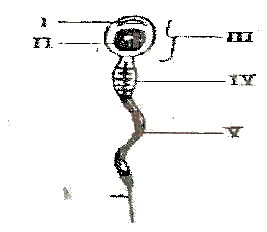
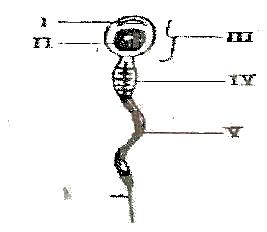
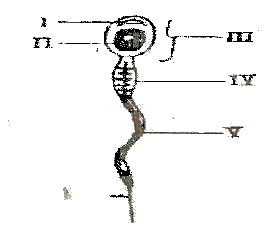
Which of the labelled structures is the nucleus?
Respondre
(B)
II
21
Which of the following labelled structures secretes enzymes which facilitate penetration
of the egg?
Respondre
(A)
I
22
Which of the following labelled structures is similar to the locomotory structure in
Euglena?
Respondre
(E)
V
23
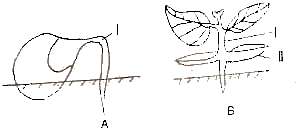
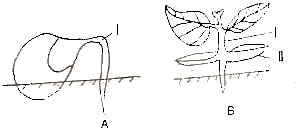
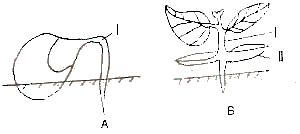
The part labelled I in A represents the
Respondre
(C)
hypocotyl
24
The part labelled II represents the
Respondre
(D)
cotyledon
25
What is the importance of the part labelled II to the seedling?
It
Respondre
(D)
provides the seedling with food
26
In grasshopper/cockroach digestion starts from the
Respondre
(E)
mouth
27
In a water culture experiment, the culture solution in a transparent beaker turned green. What precaution
should have been taken to prevent the culture solution from turning green?
Respondre
(C)
Covering the transparent beaker with black cloth
28
Which of the following is responsible for the conversion of nitrites to nitrates in the nitrogen cycle?
Respondre
(B)
Nitrifying bacteria
29
Hydra captures small crustaceans by means of
Respondre
(C)
tentacles
30
Which of the following processes is not due to interaction between the biotic and abiotic components of an
ecosystem?
Respondre
(D)
Osmosis
31
The entire habits and habitat of an organism can be described as its
Respondre
(B)
ecological niche
32
Which of these is not a true characteristic of the tropical rain forest?
Respondre
(C)
Annual rainfall is less than 100 cm
33
The frequency of andropogon in a grass lawn is 90 by 100. Throws were made with 1 meter square quadrat.
What is the density of andropogon in the field?
Respondre
(B)
0.90 per m2
34
Which of the following is the correct method of collecting soil organism?
Respondre
(E)
Placing a lighted electric bulb over soil in a funnel
35
Which of these groups of organisms is responsible for capturing energy for the biotic community?
Respondre
(D)
Producers
36
Which pathway directly leads to transfer of useful energy within a biological community?
Respondre
(B)
II and III only
37
Which of the following pathways will energy follow to reach plasmodium in the red blood cells?
Respondre
(C)
II only
38
What type of relationship exists in the large intestine of the sheep, between bacteria and the sheep?
Respondre
(A)
Symbiosis
39
The Tulgren’s funnel is used to
Respondre
(A)
extract minute soil organisms
40
Which of the following is not an aquatic habitat?
Respondre
(C)
Rainforest
41
Which of these materials is not required for insect collection in an ecological field-trip?
Respondre
(B)
Secchi disc
42
The factors which determine the type of vegetation a particular habitat will support are related to the
following except
Respondre
(E)
depth of the water-table
43
Which of the following statements is not true of population?
Respondre
(B)
Members of a population may be of the same species but do not interbreed
44
Which of the following is an abiotic factor which affects a population?
Respondre
(E)
Temperature
45
One of the ecological conditions which favour the spread of malaria is
Respondre
(D)
presence of stagnant water in ponds
46
Which of the following resources is non-renewable?
Respondre
(B)
Minerals
47
The following are the effects of overgrazing except
Respondre
(C)
epidemic of cattle diseases
48
Which of the following is not a way of conserving natural resources?
Respondre
(D)
Encouraging poaching
49
The need for conservation includes the following except to
Respondre
(D)
make sure the natural resources are not used
50
Which of these is not a hereditary variation?
Respondre
(A)
Infant paralysis
51
One of Mendel’s experiments was repeated by crossing a red variety of pepper with that of a yellow variety
which produced all red offspring. The red offspring were then self pollinated and these produced both red
and yellow pepper. The yellow colour can be said to be
Respondre
(B)
recessive to red
52
Which of the following statements is not true about chromosomes?
Respondre
(C)
Homologous chromosomes do not occur in pairs naturally
53
Cross-breeding is a way of
Respondre
(E)
applying the principles of heredity in agriculture
54
The wings of bats and birds, the flippers of whale and the fins of fish are examples of